
 Can Tho
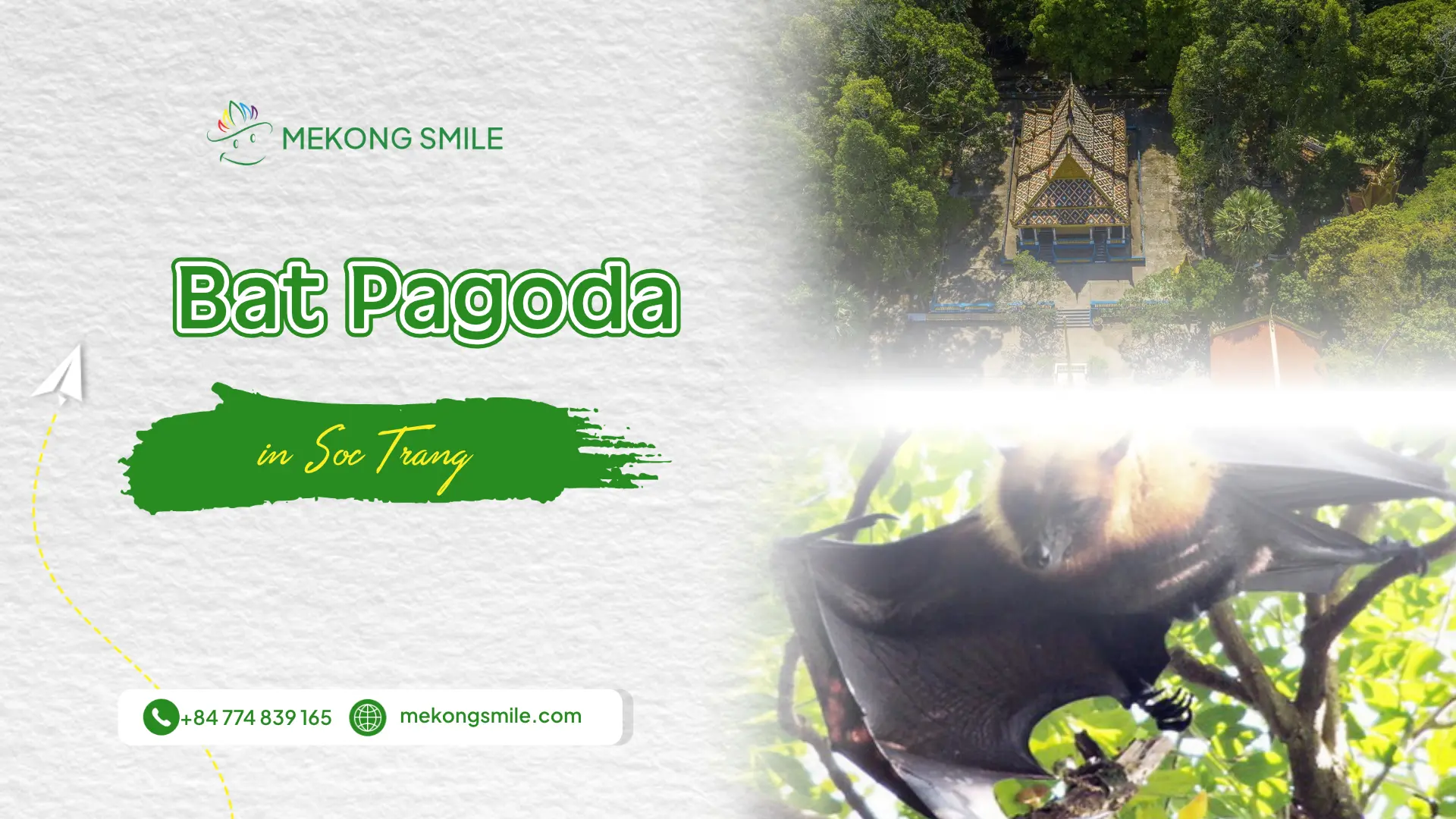
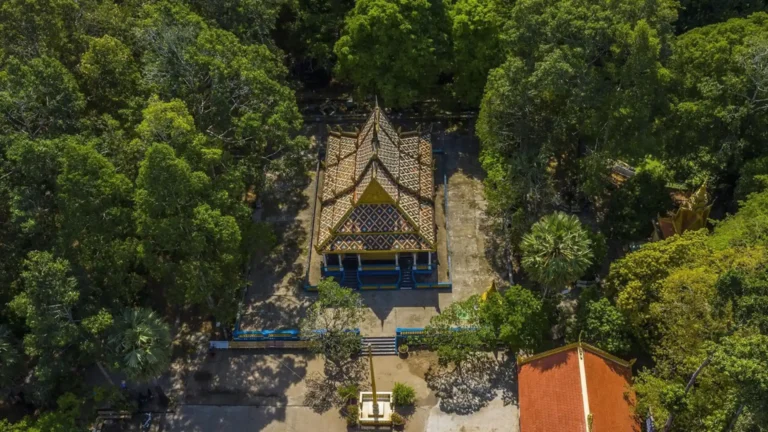

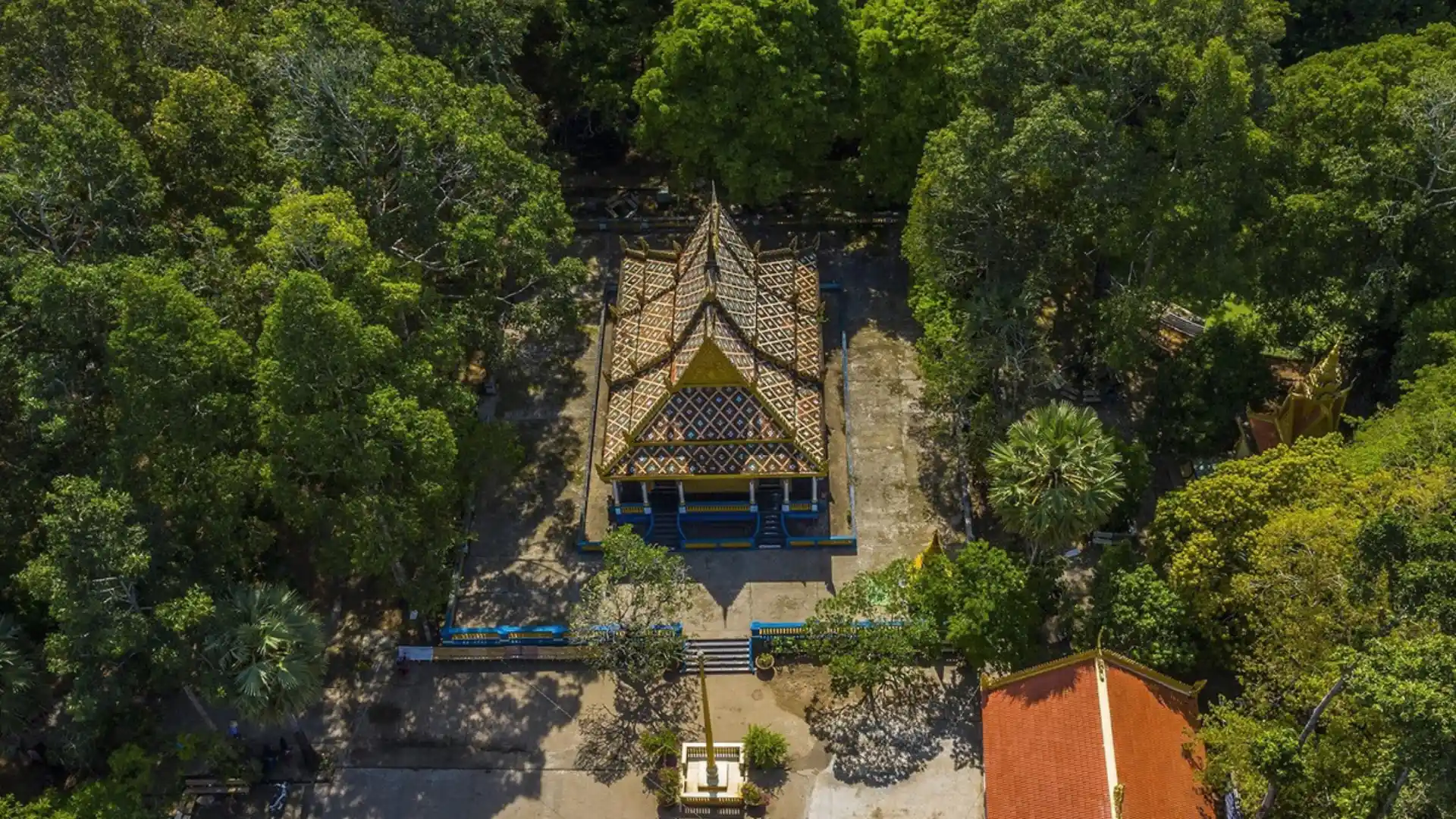
Bat Pagoda (Chua Doi), also known as Mahatup Pagoda, is a Khmer Theravada Buddhist temple founded in 1569. It stands in the former Soc Trang city, now part of Can Tho City, and is known for its Khmer architecture and for the flying foxes, large fruit bats, that roost in the tall trees on its grounds.
The bat colony has declined sharply over the years, so you should not expect the huge numbers described in older guides. The pagoda is still a rewarding place to learn about Khmer culture, Buddhist traditions and the wildlife of the Mekong Delta.
After Vietnam’s 2025 administrative changes, the pagoda’s address is Phu Loi Ward, Can Tho City. Older travel guides and some online listings still place it in Ward 3, Soc Trang City, Soc Trang Province. The temple itself has not moved.
Bat Pagoda at a glance
| Information | Details |
|---|---|
| Official name | Mahatup Pagoda |
| Other names | Bat Pagoda, Chua Doi (Chùa Dơi), Ma Toc Pagoda (Chùa Mã Tộc) |
| Location | 181 Van Ngoc Chinh Street, Phu Loi Ward, Can Tho City, Vietnam |
| Former address | Ward 3, Soc Trang City, Soc Trang Province (before 2025) |
| Established | 1569 |
| Religious tradition | Khmer Theravada Buddhism |
| Heritage status | National-level architectural and artistic relic (1999) |
| Entrance fee | No entrance fee for the pagoda; visitors report a parking fee outside |
| Listed opening hours | 7:00 AM-6:00 PM (Can Tho tourism portal) |
| Suggested visit duration | 45-90 minutes (our suggestion; longer if you wait for the bats) |
| Best time to visit | Morning for architecture; late afternoon, from about 4:00 PM, for the bats (our suggestion) |
| Main attractions | Khmer architecture, flying foxes, five-toed pig tombs, Ngo racing boat |
| Dress code | Shoulders and knees covered; shoes off inside the halls |
| Getting there | About 65 km by road from Ninh Kieu Wharf, around 1.5 hours by car |
| Google Maps | Chùa Dơi (Bat Pagoda) |
The history of Bat Pagoda
Bat Pagoda was founded in 1569, with Thach Ut, a local Khmer man, leading its construction. The first temple was built of wood and roofed with water palm leaves, among old trees. The main sanctuary was rebuilt in concrete with a tiled roof in 1960.
A fire destroyed the main sanctuary in 2007. It was rebuilt in the traditional style over the following years, so the hall you see today is a reconstruction.
In 1999, Vietnam’s Ministry of Culture and Information recognized the pagoda as a national-level architectural and artistic relic.
The names of the pagoda
The pagoda has several names, which can be confusing on maps and in guidebooks:
- Mahatup Pagoda: the name used by the Can Tho tourism portal. It comes from the temple’s Khmer name, written in Vietnamese sources as Sêrây Têchô Mahatúp.
- Ma Toc Pagoda (Chùa Mã Tộc): the Vietnamese pronunciation of Mahatup. Some older English guides spell it “Matoc”.
- Bat Pagoda (Chùa Dơi): the popular name, from the bats. Over time it became the name most people use.
In a map app, search for “Chùa Dơi Sóc Trăng” or “Mahatup Pagoda”.
The bats of Bat Pagoda
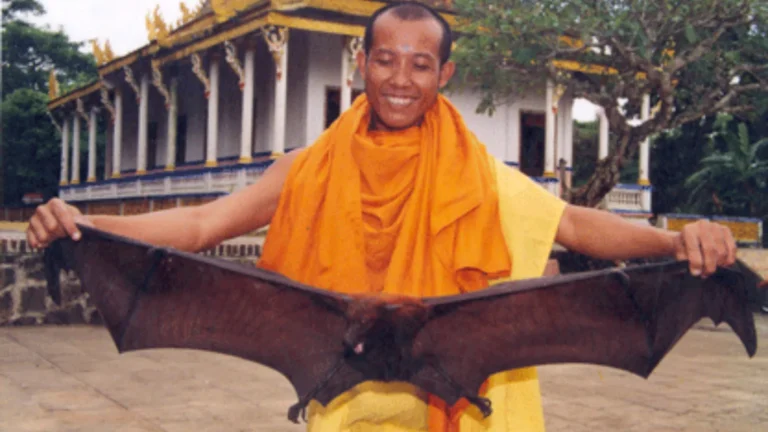
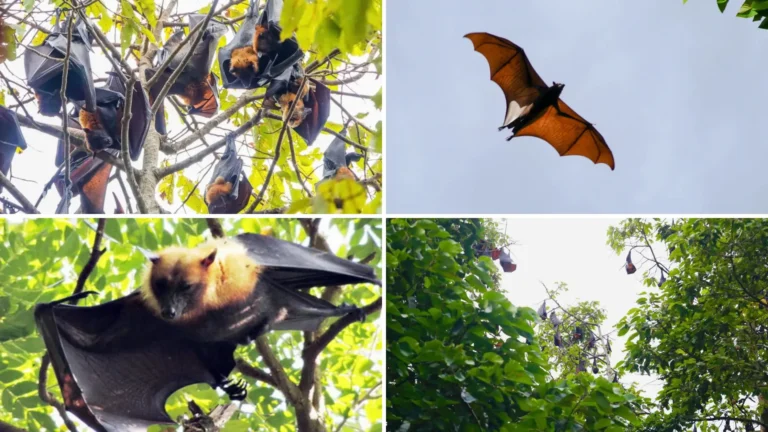
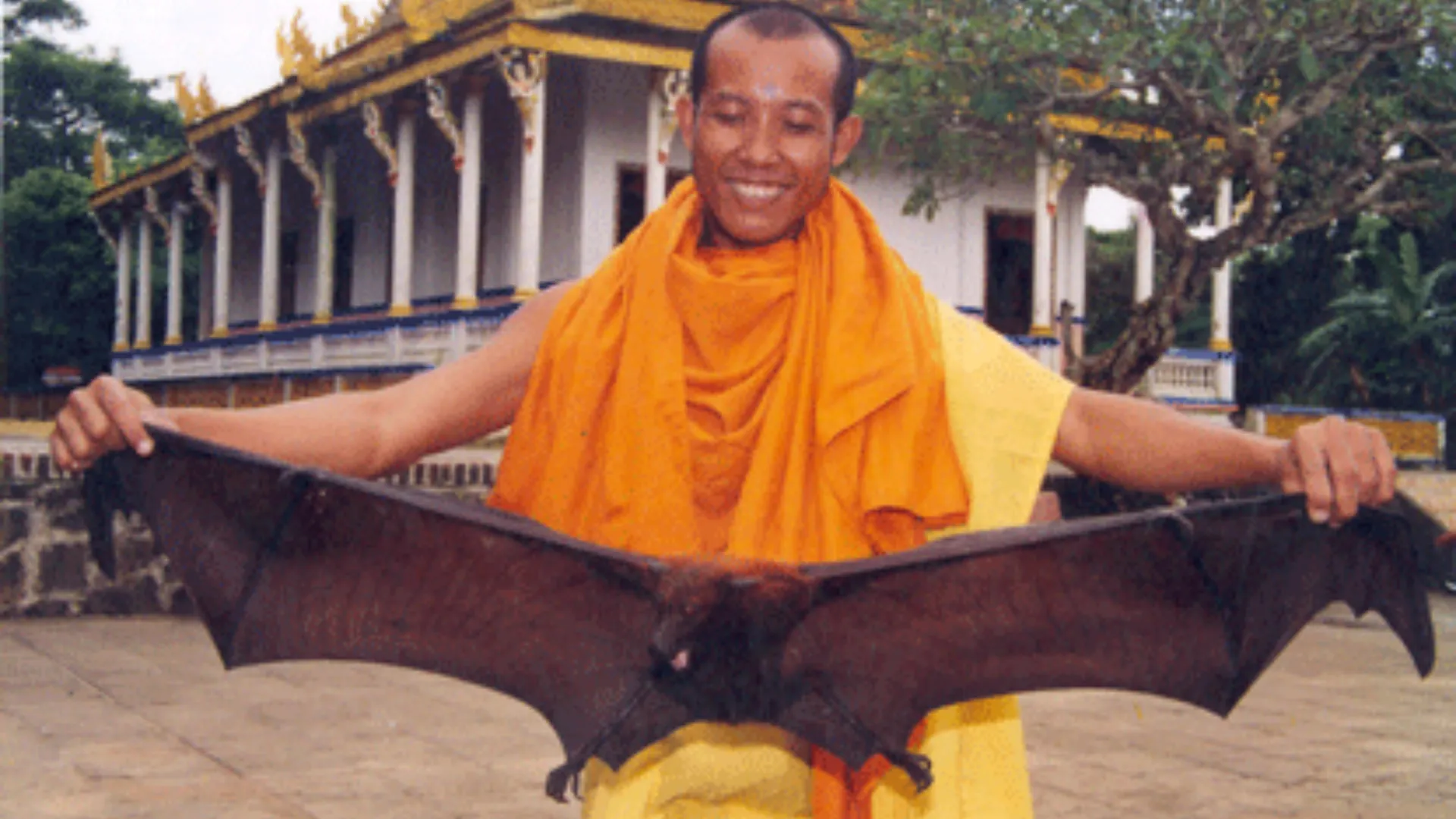
The bats here are flying foxes, large fruit bats that roost in trees during the day. Local media have reported wingspans of around 1 to 1.5 meters, with some larger individuals reaching approximately 2 meters.
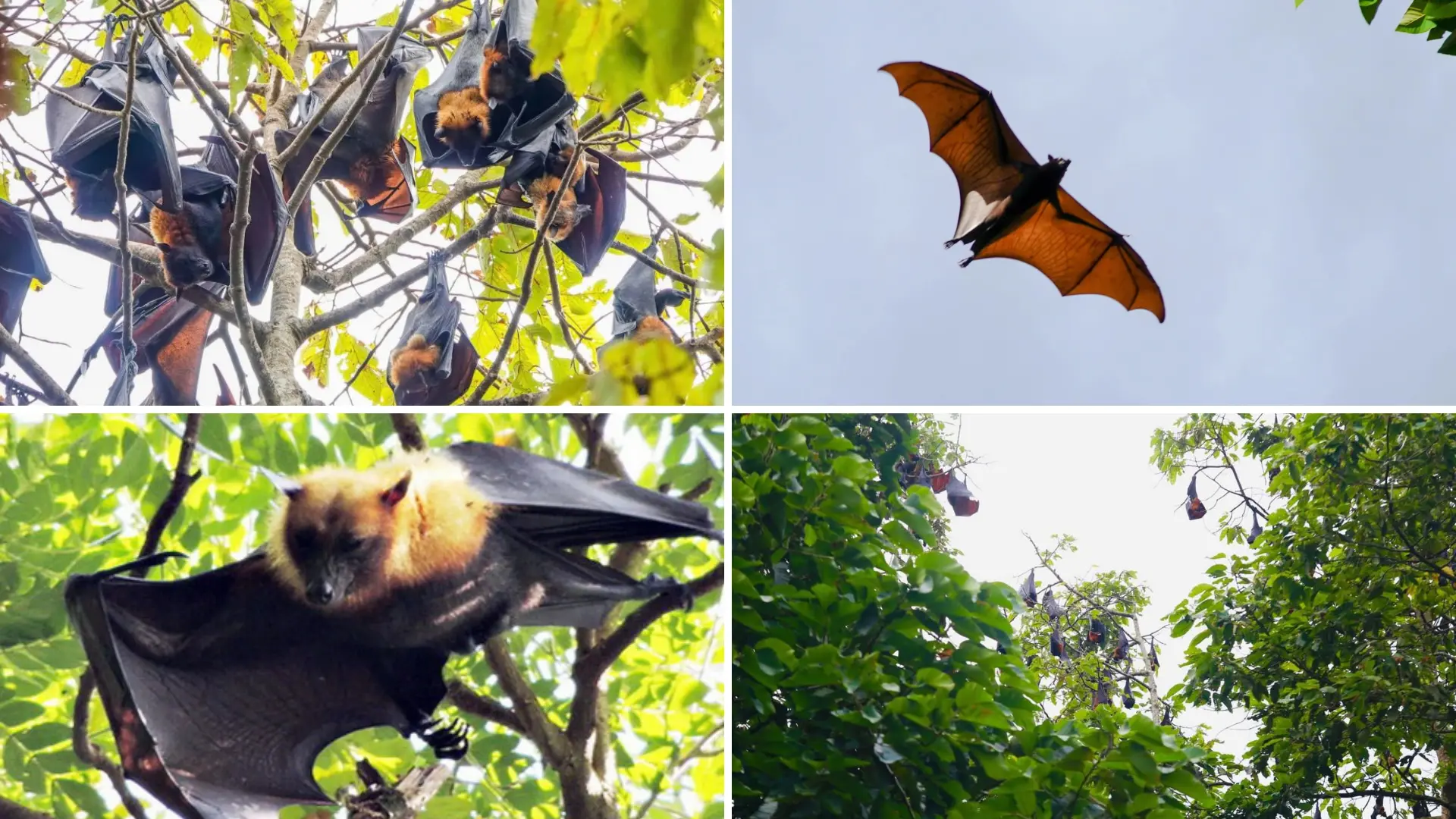
A scientific survey conducted in 2014 identified Lyle’s flying fox (Pteropus lylei) among the bats roosting at the pagoda. Researchers also recorded a second flying fox species, although its identification was preliminary.
By day, the bats hang from high branches, wrapped in their wings, and you may need to look carefully into the treetops to spot them. They generally become more active toward dusk, then leave to feed on fruit and return to the trees before dawn. Visitors describe the colony as large, lively and noisy, with plenty of squeaking and wing flapping among the branches.
Why the bats live at the pagoda
The grounds cover about 4 hectares and are shaded by tall sao and dau trees, native hardwoods that offer the bats high, quiet roosts. A 2014 scientific survey noted that although the study site had nearly a thousand trees, the flying foxes roosted in only a few of them.
The monks and the local Khmer community have long treated the bats’ presence as a blessing, which has helped make the temple a refuge for them.
Local folklore adds two stories. One says the bats never eat the fruit growing on the temple grounds and always fly far away to feed. The other says that when the colony returns at dawn, it circles the temple but never flies straight over the roof of the main sanctuary. These are local beliefs, not scientific observations.
The bats also attract many visitors of Chinese heritage. In Chinese, the word for bat sounds like the word for good fortune, so the bat is a lucky symbol.
How many bats are left?
Older guides describe “thousands” or even “millions” of bats. Those figures do not reflect the colony today. Here is what different sources recorded, and how:
- Living memory: monks and older residents remember tens of thousands of bats several decades ago. These are recollections, not counts.
- 2009: Vietnamese scientists reported nearly 1,500 to 2,000 flying foxes at the pagoda.
- 2014: a monthly scientific survey of the Soc Trang colony counted between 453 bats in April and 1,753 in February, showing how much numbers can change through the year.
- January 2024: a Tuoi Tre reporter saw a little more than 100 bats in the treetops one morning.
- August 2026: a local resident told Tuoi Tre he believed there were only about 300 to 400 bats at most, and reporters found bats roosting in only three or four old trees.
Hunting is the main cause of the decline named by scientists and local officials. The bats fly far from the pagoda to feed, and some are caught and sold to restaurants. Flying foxes also breed slowly, with one young a year, so losses are hard to replace.
Local authorities have asked restaurants not to buy or sell bats and warned of penalties, but officials say enforcement is difficult.
Wildlife sightings vary from day to day, and no one can promise that you will see the bats. You can help by never eating bat meat, keeping your voice down near the roosting trees, and not using flash or drones around them.
What to see at Bat Pagoda
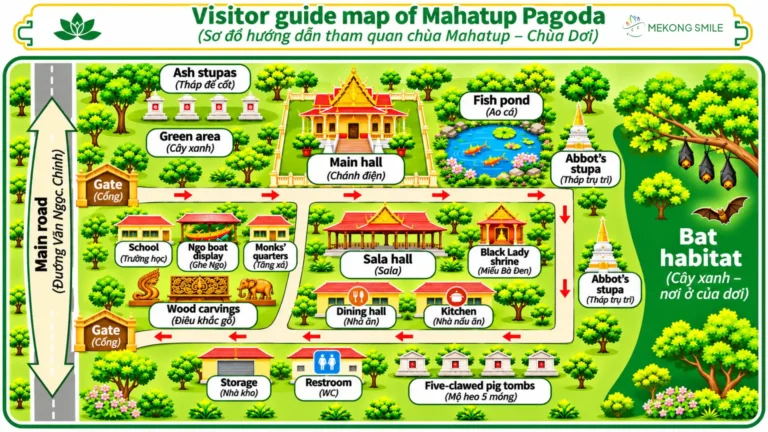
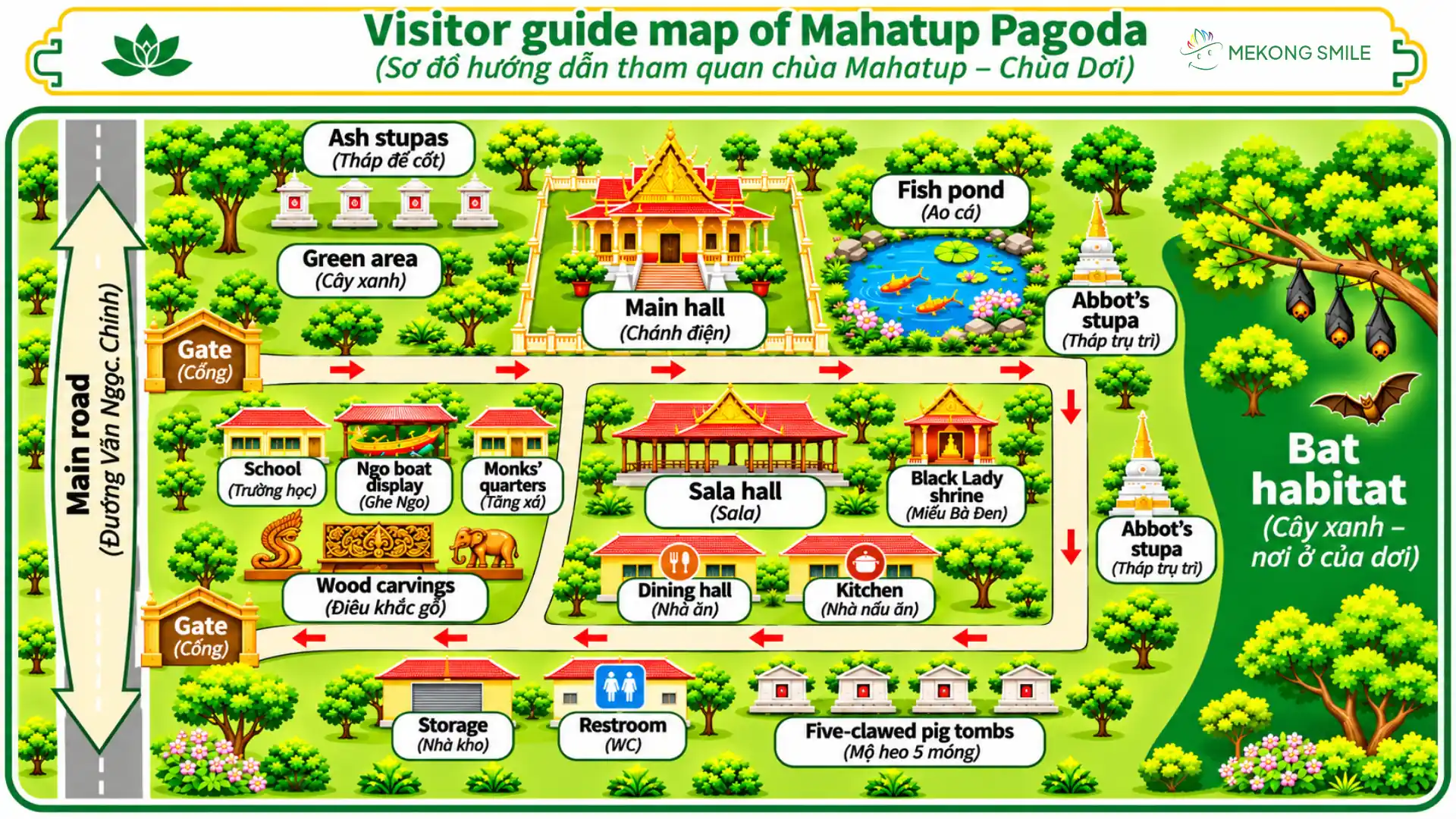
Even on a day when the bats are hard to spot, the temple itself is worth the visit. The illustrated map below shows the main areas of the grounds.
The main sanctuary
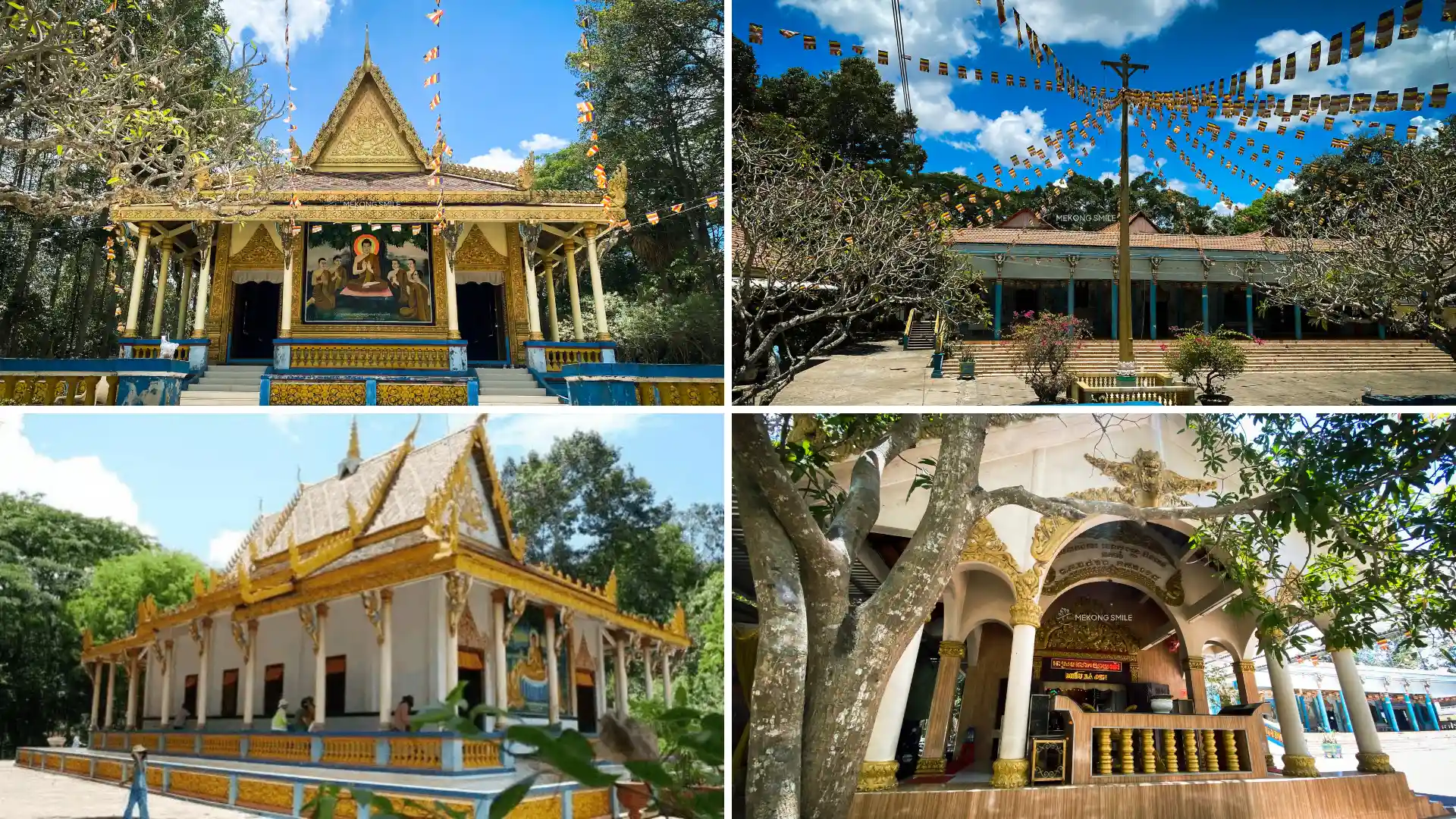
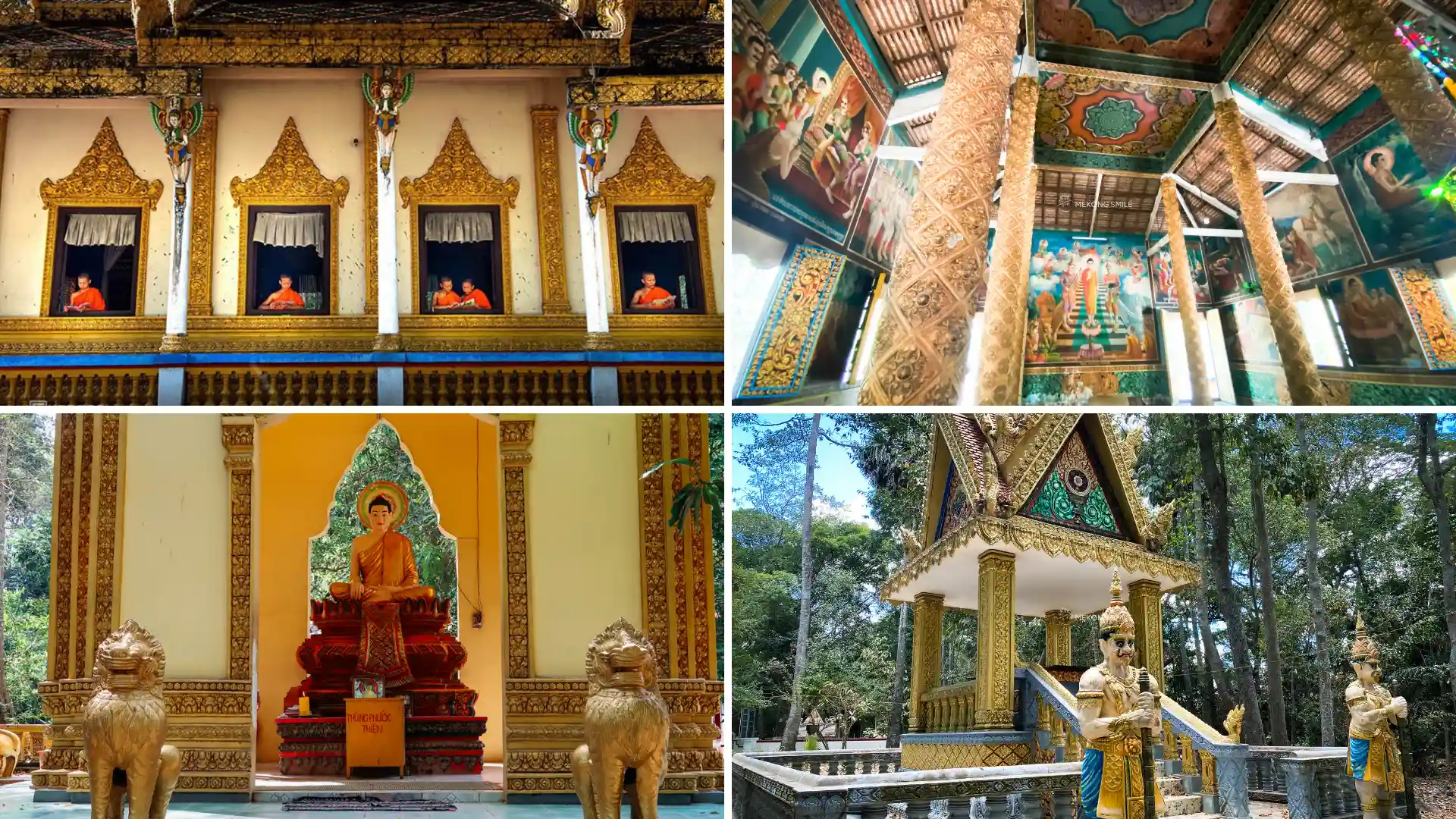
The main sanctuary (chánh điện) is the religious heart of the pagoda. The curved ends of its layered roof rise into heads of the Naga, the serpent that protects Buddhist spaces in Khmer art. Around the hall, each column carries a Kemnar, a celestial maiden with her palms pressed together in greeting.
Inside, the main altar holds a stone statue of the Buddha seated on a lotus pedestal. Look also for an image of the Buddha sheltered by Muchalinda, the many-headed serpent king. Remove your shoes before entering.
The tombs of the five-toed pigs
Behind the main buildings are small tombs built for pigs. In local belief, a pig born with five toes instead of the usual four has a spirit of its own and can bring trouble to the family that keeps it. Families used to bring such pigs to the pagoda, where they lived out their lives and were buried on the grounds.
Vietnamnet counted three of these tombs in 2025 and reported that the pagoda no longer accepts new pigs. This is a local folk custom rather than a Buddhist teaching, so treat the tombs with the same respect as the rest of the temple.
The Ngo racing boat
Like many Khmer pagodas in the area, Bat Pagoda has its own Ngo boat, the long, narrow racing boat paddled by dozens of rowers during the Ooc Om Boc Festival.
Sala, stupas and monks’ quarters
The complex also includes the Sala, the hall where the community gathers for ceremonies, the monks’ living quarters and stupas that keep the ashes of former abbots and respected Buddhists. This is a working temple where monks live and study, so walk around quietly. Recent visitors also mention a small shrine to Ba Den (Mieu Ba Den) next to the pagoda.
What to expect around the pagoda
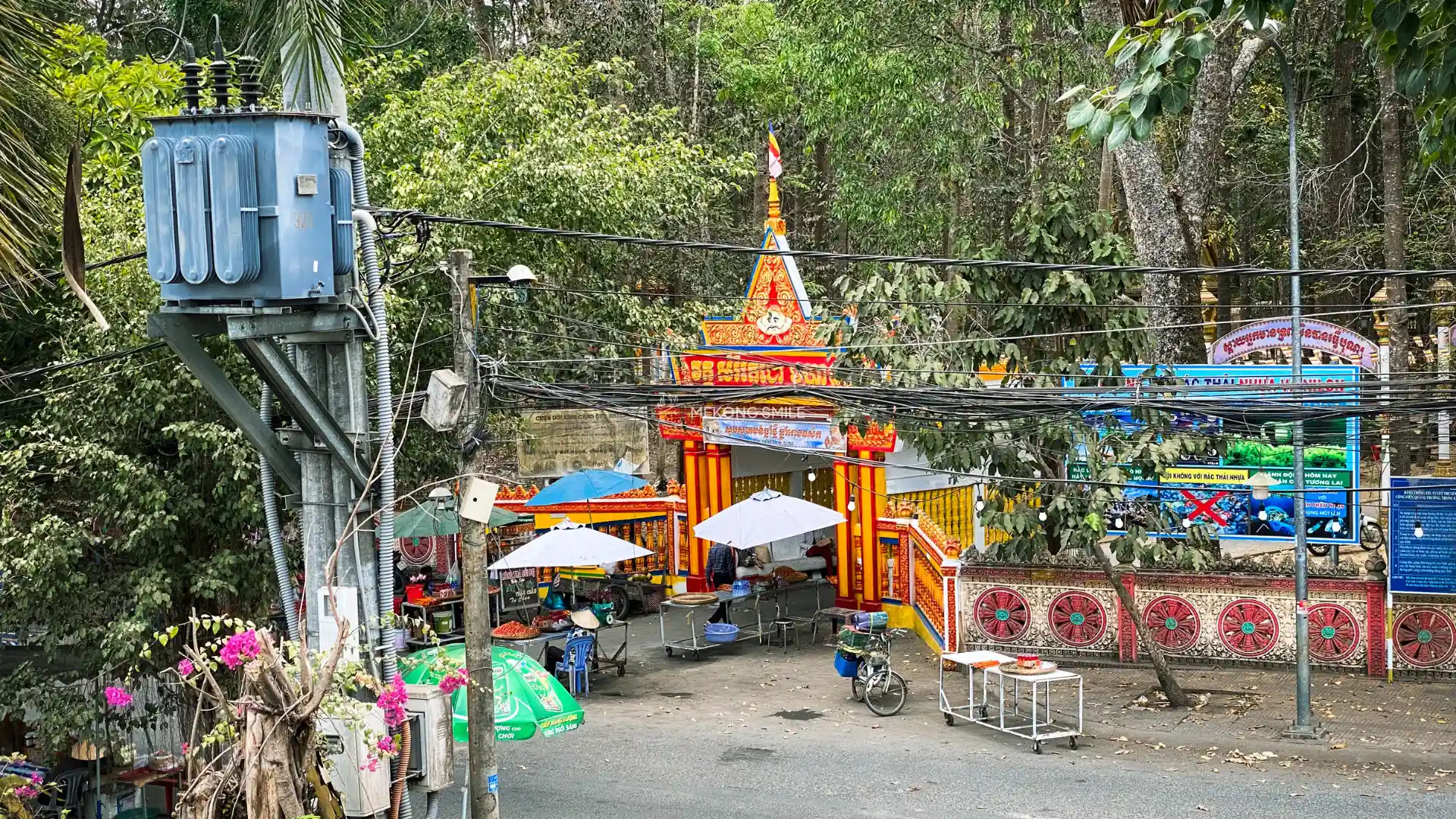
Like many popular temples in the Mekong Delta, Bat Pagoda and its surroundings are lively and informal. Near the entrance and along the paths you may meet vendors, including people selling fish food, as well as older visitors and children who ask for money. A friendly “no, thank you” works well. If you would like to give, the temple’s donation box is the simplest way to support the pagoda.
The grounds are shady and atmospheric, though some corners show their age and are waiting for restoration. Recent visitors also report that the QR code for temple information was not working.
The bats can be loud, and mosquitoes can be plentiful under the trees. If you are traveling with children, bring insect repellent.
How to get to Bat Pagoda
Bat Pagoda is at 181 Van Ngoc Chinh Street, Phu Loi Ward, Can Tho City, about 2.5 km from the former Soc Trang city center.
From central Can Tho
The pagoda is not in Ninh Kieu, the riverside center of Can Tho where most visitors stay. Google Maps gives a driving route of about 65 km from Ninh Kieu Wharf, mostly along National Highway 1A, which takes around 1.5 hours depending on traffic. Treat it as a day trip, not a quick stop between city sights.
A private car or a prearranged transfer is the most practical way to go, especially if you want to visit several Khmer temples in one day.
Google Maps directions from Ninh Kieu Wharf to Bat Pagoda
Combining it with other Khmer sites
Three other well-known Khmer temples are a short drive away. Driving between all four is about 22 km in total. The order below follows the geography and saves the bats for the late afternoon:
- Som Rong Pagoda, known for its giant reclining Buddha, in the former city center.
- Khleang Pagoda, on the same street as Som Rong.
- Chen Kieu Pagoda, famous for its porcelain mosaics, about 12 km southwest along Highway 1A.
- Bat Pagoda in the late afternoon, on your way back toward the city center and Can Tho.
Including the round trip from Ninh Kieu Wharf, plan on about 150 km and roughly 3.5 hours of driving for the day, plus time at each temple.
When to visit Bat Pagoda
The Can Tho tourism portal lists visiting hours from 7:00 AM to 6:00 PM. However, published opening hours vary, so confirm access before planning a late-afternoon visit.
For the bats, come in the late afternoon, from about 4:00 PM, and stay until closing time. The bats tend to become more active as the light fades. They usually fly out to feed around dusk, which may be after closing time, so do not plan your trip around seeing them leave.
For the architecture, the morning is cooler and quieter, with softer light on the sanctuary roof.
Khmer festivals bring the temple to life. The Kathina robe-offering season, an important event at the pagoda, runs from the 15th day of the ninth lunar month to the 15th day of the tenth lunar month, usually around October and November. The Ooc Om Boc Festival and its Ngo boat races follow around the full moon of the tenth lunar month. Expect bigger crowds on festival days and at weekends.
Practical tips for visiting Bat Pagoda
- Clothing: Cover your shoulders and knees. Bring a light scarf or long pants if you are traveling in shorts.
- Shoes: Take them off before entering the main sanctuary and the Sala.
- Near the trees: Speak softly and avoid shouting, clapping or anything that could disturb the bats.
- Photography: Use a zoom lens instead of moving closer, and turn off your flash. Do not fly drones over the roosting trees. Ask before photographing monks or worshippers.
- Wildlife: Never touch, feed or try to catch the bats.
- Statues: Do not let children climb on statues or railings.
- Mosquitoes: Bring insect repellent, especially if you travel with children. Mosquitoes can be plentiful under the trees, and more so in the late afternoon.
- Weather: Carry water and a hat, and a light raincoat in the rainy season.
- Fees: There is no entrance fee for the pagoda, and recent visitors report that parking inside the pagoda grounds is free. Earlier visitors mentioned a parking fee at the tourist area outside, so check before you park. If you want to support the temple, use the donation box.
Is Bat Pagoda worth visiting?
Yes, if you are interested in Khmer culture, temple architecture or wildlife, or if you are already traveling through the former Soc Trang area. A 450-year-old temple with a wild bat colony in its trees is an unusual sight, even in the Mekong Delta.
Go with realistic expectations. You may see only a few hundred bats, or fewer, high in the trees, and the area around the pagoda can be busy and a little untidy. If bats are your only reason to make the drive from central Can Tho, the trip may disappoint you. Combined with Som Rong, Khleang and Chen Kieu, it makes a rewarding day of Khmer heritage.
If you only have a few hours in Can Tho, Munir Ansay Pagoda in the city center is a closer way to see Khmer temple architecture.
Explore Khmer heritage in the Mekong Delta
Bat Pagoda is one of many Khmer temples in the former Soc Trang area. Find more places to explore in our Can Tho destination guides and the Can Tho travel guide.
For a different Khmer cultural experience closer to central Can Tho, our Vinh Long tour from Can Tho combines a visit to Phu Ly Pagoda with local waterways and a traditional tofu skin workshop in Vinh Long.
Need help planning your trip?
Planning to visit Bat Pagoda, Som Rong Pagoda or other Khmer sites in the Mekong Delta? Tell us your interests, starting point and available time, and our team in Can Tho will suggest a plan that fits.
- Hotline and WhatsApp: +84 774 839 165
- Email: contact@mekongsmile.com
- Office: No. 5 Tran Van Hoai Street, Ninh Kieu Ward, Can Tho City, Vietnam
Planning Your Mekong Trip?
Get a free, personalized itinerary from our local experts in under 120 minutes.

Get a Free Consultation Leave your contact, we handle the rest.
Frequently asked questions about Bat Pagoda (FAQ)
Where is Bat Pagoda?
Bat Pagoda is at 181 Van Ngoc Chinh Street, Phu Loi Ward, Can Tho City, Vietnam. Before Vietnam’s 2025 administrative changes, the address was Ward 3, Soc Trang City, Soc Trang Province.
Is Bat Pagoda in Soc Trang or Can Tho?
Both names are used. The pagoda is in the former Soc Trang city, which became part of Can Tho City in 2025. Many guides and maps still list it under Soc Trang.
Are there still bats at Bat Pagoda?
Yes, but far fewer than in the past. In August 2026, a local resident estimated about 300 to 400 bats at most, and reporters found them in only a few trees. Sightings vary, so seeing the bats is not guaranteed.
What kind of bats live at Bat Pagoda?
They are flying foxes, large fruit bats that roost in trees. A 2014 scientific survey identified Lyle’s flying fox among the bats roosting at the pagoda.
When is the best time to see the bats?
The Can Tho tourism portal lists visiting hours from 7:00 AM to 6:00 PM. However, published opening hours vary, so confirm access before planning a late-afternoon visit. The bats tend to become more active as the light fades.
Is there an entrance fee?
There is no entrance fee for the pagoda itself. Recent visitors report that parking inside the pagoda grounds is free, and donations to the temple are welcome.
How long does it take to get there from Can Tho?
The drive from Ninh Kieu Wharf is about 65 km and takes around 1.5 hours by car, depending on traffic.
How old is Bat Pagoda?
The pagoda was founded in 1569, which makes it more than 450 years old. The main sanctuary was rebuilt after a fire in 2007.
Is Bat Pagoda the same as Mahatup or Ma Toc Pagoda?
Yes. Mahatup comes from the temple’s Khmer name, and Ma Toc is the Vietnamese pronunciation of it. Chua Doi means Bat Pagoda in Vietnamese.
What should I wear?
Wear clothing that covers your shoulders and knees, and be ready to take off your shoes before entering the halls.

