
 Can Tho
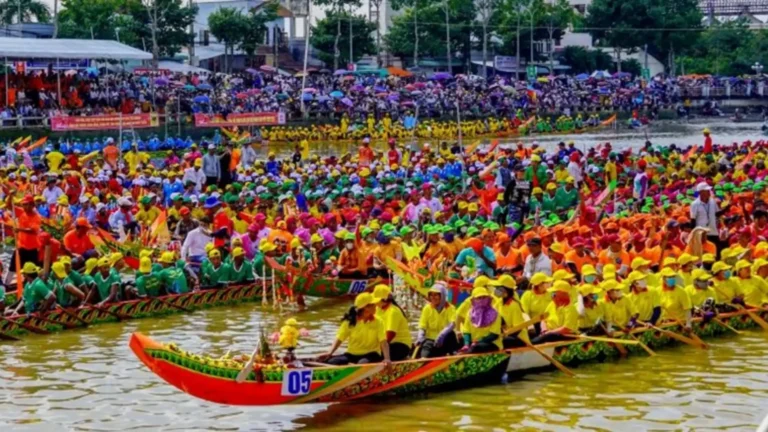
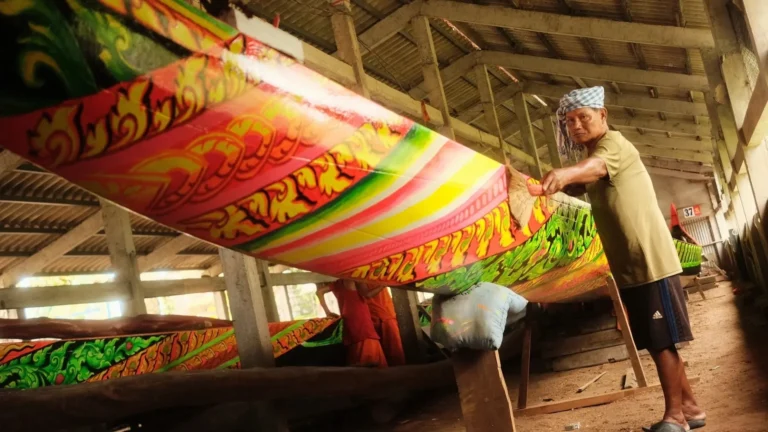
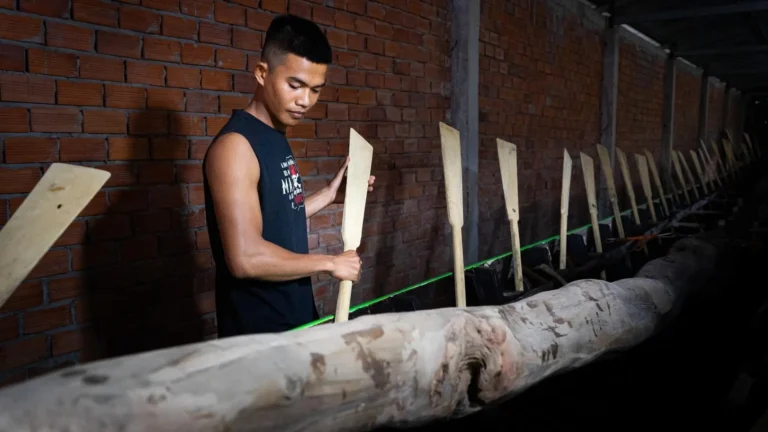
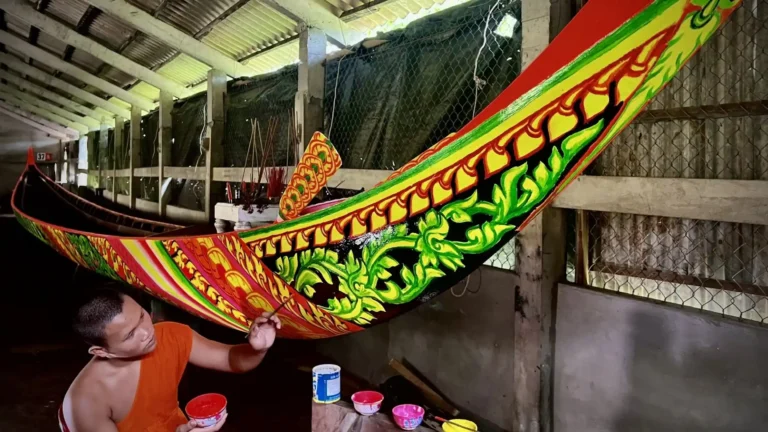

A Ghe Ngo is a traditional Khmer racing boat from southern Vietnam, especially associated with the Mekong Delta. Long, narrow and brightly decorated, these wooden boats carry teams of paddlers who compete during the Ooc Om Boc Festival.
For Khmer communities, however, a Ghe Ngo is more than racing equipment. Often maintained by a Buddhist pagoda and its surrounding villages, the boat represents shared identity, craftsmanship and spiritual beliefs.
Its curved wooden hull, colorful animal symbols and synchronized paddling make it one of the region’s most distinctive traditional boats.
What is a Ghe Ngo?
Ghe Ngo, also called an Ngo boat or Khmer racing boat in English, is a long wooden vessel designed for competitive paddling. Unlike the smaller boats used for fishing, carrying passengers or navigating narrow canals, it is closely associated with ceremonial races and community celebrations.
Ghe Ngo at a glance:
- Vietnamese name: Ghe Ngo (ghe ngo)
- Other name: Tuk Ngo, as recorded in Vietnamese cultural documentation
- Cultural origin: Khmer communities in southern Vietnam
- Typical length: Often around 25-30 meters, although sizes vary
- Crew: Commonly several dozen paddlers, often around 40-60; some boats and competitions accommodate more
- Construction: Traditionally carved from a large tree trunk; modern examples are also assembled from wooden planks
- Main occasion: Ooc Om Boc, the Khmer Moon Worship Festival
- Cultural role: Community racing, religious traditions and local identity
These measurements describe common examples rather than fixed specifications for every Ghe Ngo.
What does the name Ghe Ngo mean?
The name is associated with the Khmer expression Tuk Ngo.
Vietnam’s Department of Cultural Heritage records a traditional explanation in which tuk refers to a boat and ngo is associated with the curved shape of the vessel.
This explanation reflects one account of the name’s origin, rather than a definitive linguistic conclusion.
The boat’s distinctive upward-curving ends remain among its most recognizable features.
How is it different from other Mekong Delta boats?
Most traditional watercraft in the Mekong Delta developed around practical needs, including transportation, fishing and trade. The Ghe Ngo has a different primary role.
A hand-rowed sampan might carry a few passengers through a rural canal. A large trading boat can transport goods along a river. A Ghe Ngo, by contrast, is designed for many paddlers working together in a race.
Its cultural associations are also different from those of everyday boats.
For a wider look at the region’s watercraft, read our guide to the traditional boats of the Mekong Delta.
How is a Ghe Ngo built?
From dugout boats to wooden planks
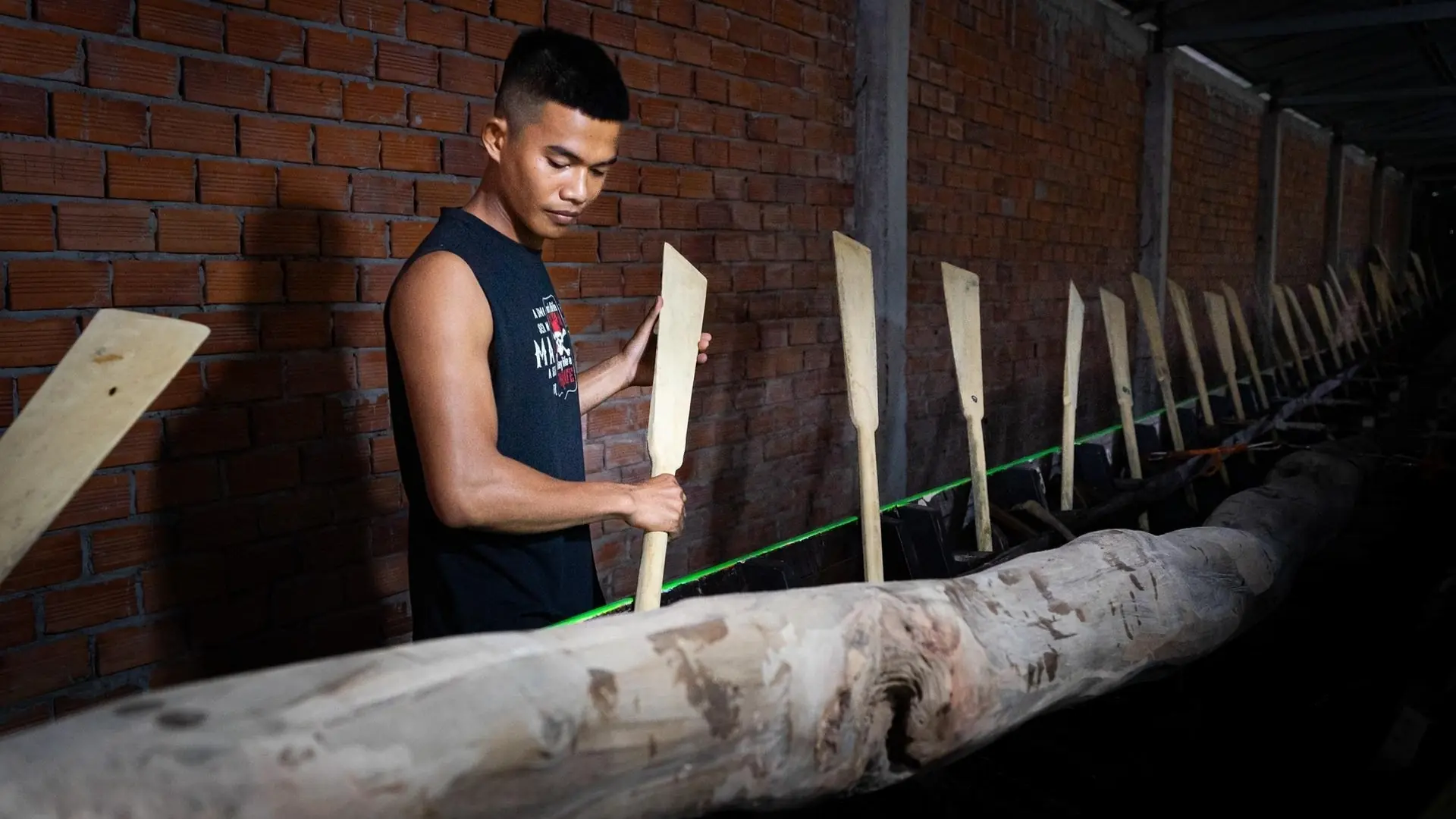
Historically, Ghe Ngo boats were made by hollowing out large tree trunks, particularly those of sao trees, a type of hardwood used in traditional Vietnamese boatbuilding.
Craftspeople shaped the wood into a long, narrow hull. The bow and stern were adapted into raised, curved forms suited to the boat’s distinctive appearance.
Finding sufficiently large timber became increasingly difficult. Over time, builders adopted methods that joined wooden planks to form the hull.
These techniques made it possible to construct large racing boats without relying entirely on a single tree trunk.
The craftsmanship involved more than shaping wood. A long racing boat requires careful attention to its hull, seating arrangements, reinforcement and balance.
What is the cây cần câu inside a Ghe Ngo?
One notable structural feature is the cây cần câu, a wooden reinforcing member found inside traditional Ghe Ngo boats.
Its arrangement is not identical on every vessel.
Vinh Long Museum describes a preserved Ghe Ngo from Ba Si Pagoda with a longitudinal wooden support extending along the hull, contributing to its structural strength.
Meanwhile, the Vietnam Museum of Ethnology documents two wooden reinforcing members inside its preserved boat from Tam Soc Pagoda.
These examples show how traditional builders adapted internal structures to support long racing hulls. The exact construction should be understood in relation to each individual boat rather than treated as a universal design.
A preserved Ghe Ngo from Ba Si Pagoda
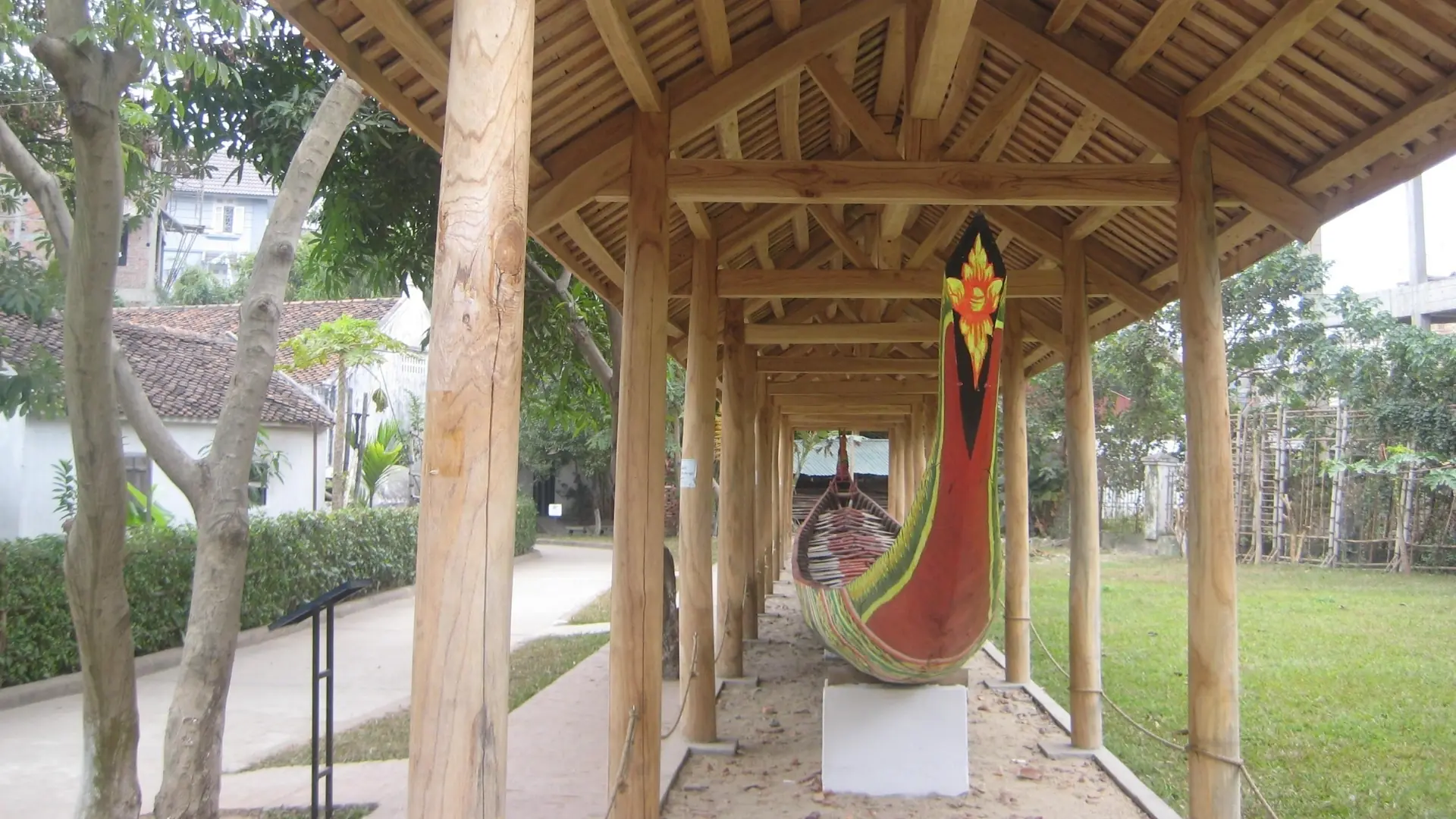
The Khmer Ethnic Culture Museum in Vinh Long Province preserves a Ghe Ngo originally associated with Pesey Vararam Pagoda, commonly known as Ba Si Pagoda.
The boat was built in 1997 by craftsman Kim Crụp, with financial contributions from four Khmer pagodas and support from local authorities.
According to research published by Vinh Long Museum in September 2026, the vessel has several notable characteristics:
- A length of 28 meters
- A hull assembled from 27 sao wood planks
- Bow and stern sections made from solid timber
- Twenty-five seating compartments, each accommodating two paddlers
- Approximately 50 paddlers and three people responsible for directing or controlling the boat during races
The vessel also features decorative patterns inspired by Makara, a mythical creature found in Khmer artistic traditions.
These details belong to this particular preserved boat. They should not be taken as standard specifications for every Ghe Ngo.
Why are Ghe Ngo boats decorated with sacred symbols?
The decoration of a Ghe Ngo is closely connected with Khmer cultural identity and spiritual beliefs.
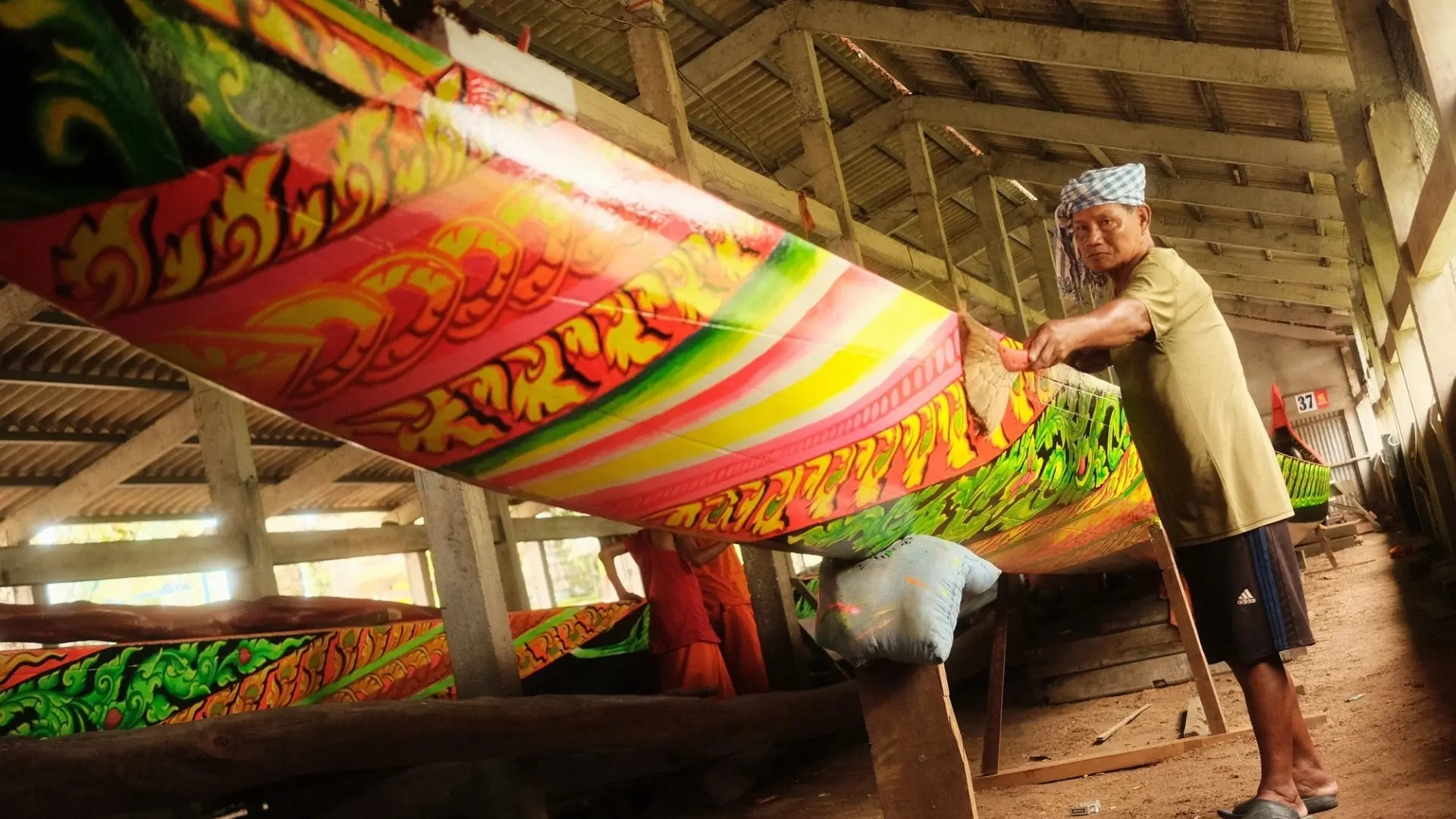
Its hull may feature brightly painted patterns, animal figures and carefully crafted details. These designs can help identify the community or pagoda associated with a racing team.
They also carry meanings that extend beyond appearance.
Animal symbols and their cultural meaning
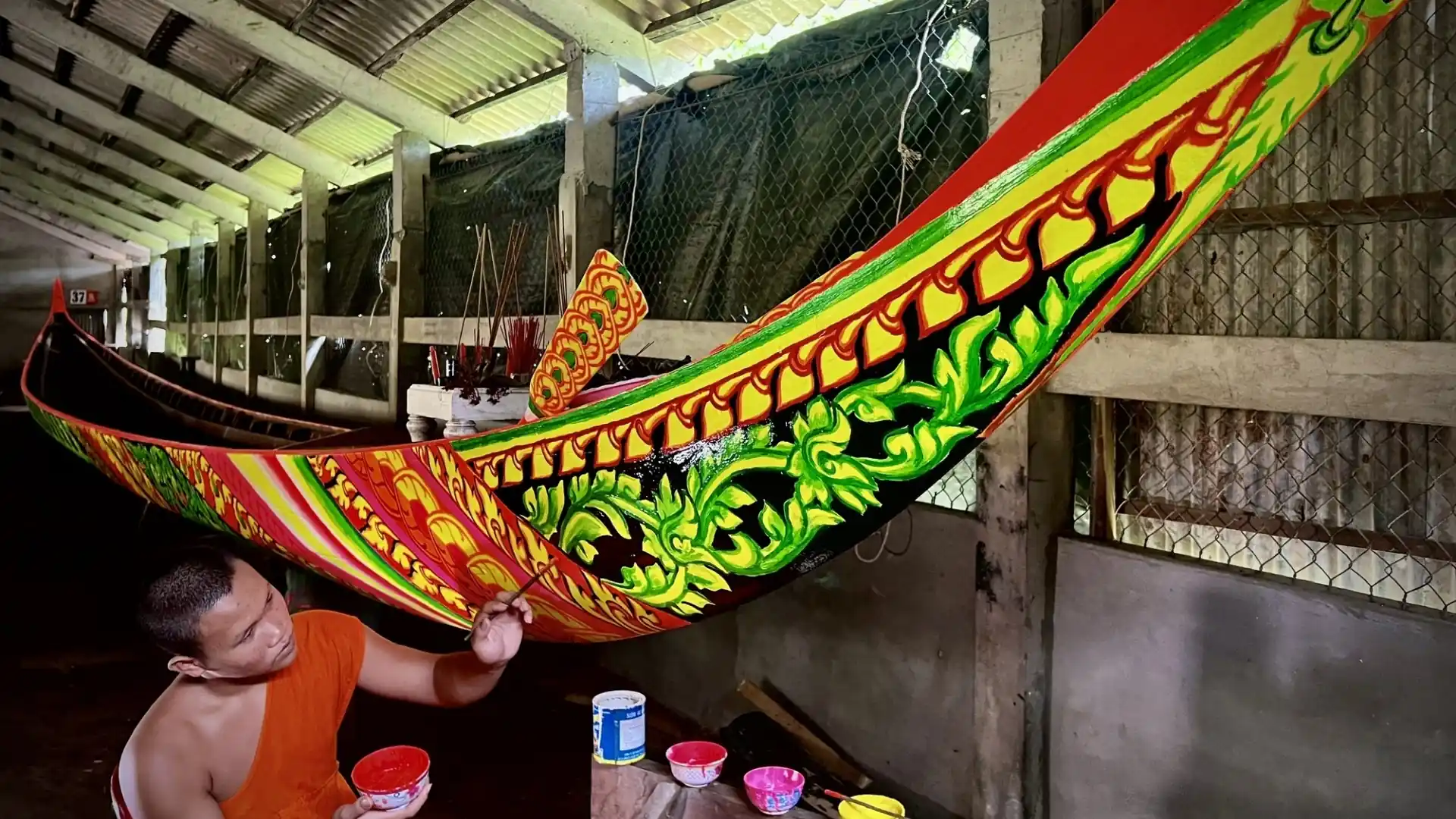
Different Khmer pagodas may select different symbolic animals for their Ghe Ngo boats.
Examples include the Naga serpent, dragon, mythical Krud bird, elephant and tiger.
The choice may relate to a pagoda’s traditions, the Khmer name of a village or religious beliefs associated with a particular animal.
These figures commonly express ideas such as protection, strength, courage and good fortune.
For example, reporting published in November 2026 describes Phu Giao Pagoda in My Xuyen Ward, Can Tho City, using a green dragon as the symbolic figure on its Ghe Ngo.
Other pagodas use different animals, giving their boats distinct visual identities.
Not every Ghe Ngo features a Naga, and no single animal should be presented as the universal symbol of all Khmer racing boats.
Why do Ghe Ngo boats have eyes?
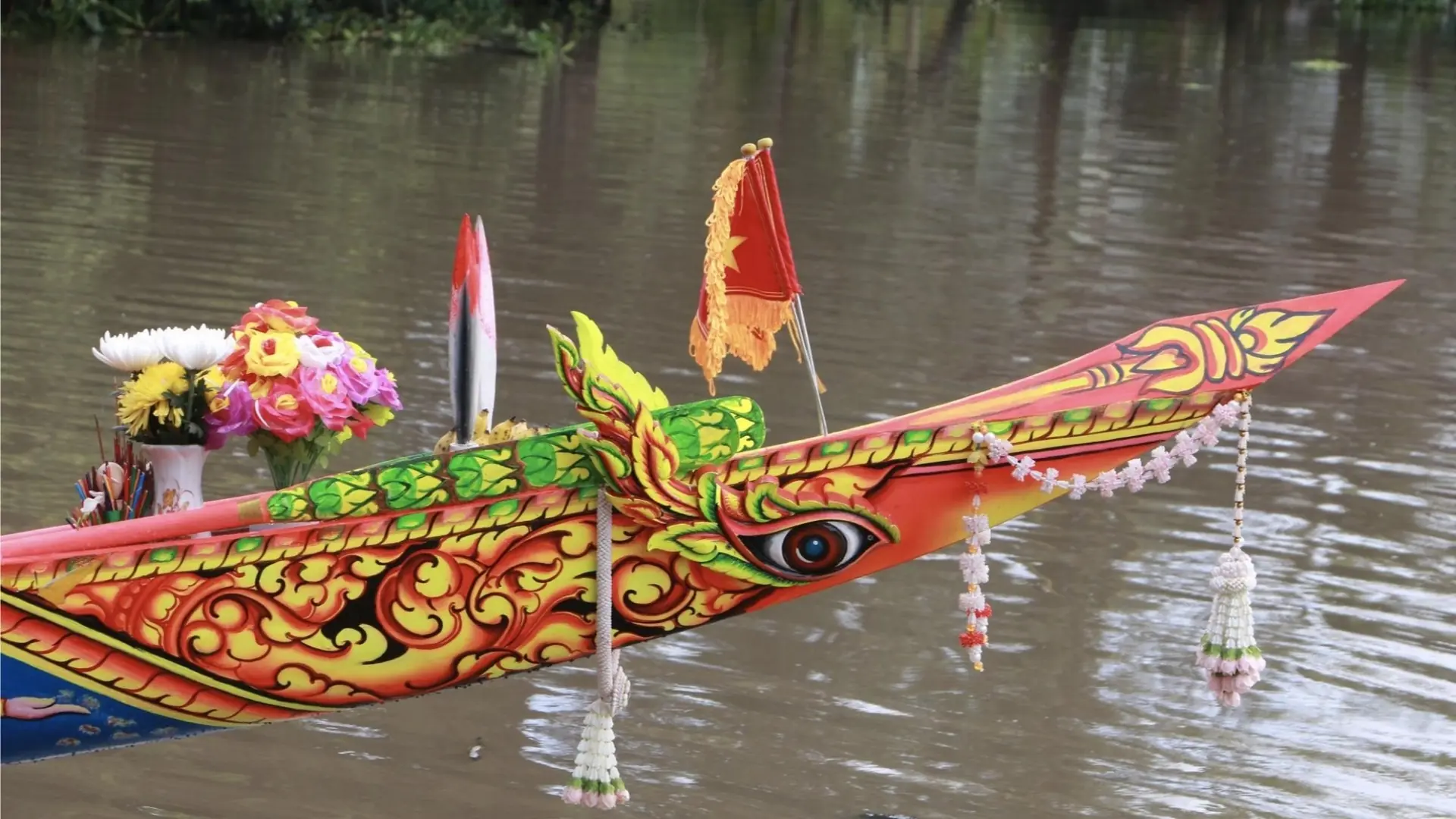
A pair of eyes is another distinctive feature of many Ghe Ngo boats.
The eyes may be painted or crafted as raised decorative elements near the bow.
In Khmer traditions, they are associated with the belief that the boat can see the way ahead, avoid danger and receive spiritual protection.
This belief reflects the boat’s sacred significance to the community. It does not mean that the eyes serve a practical navigational function.
Together with animal symbols and painted patterns, the eyes make each Ghe Ngo recognizable even before a race begins.
The Ghe Ngo’s role in Khmer community life
Why are Ghe Ngo boats associated with pagodas?
Khmer Buddhist pagodas serve as religious and cultural centers for surrounding communities. Many Ghe Ngo boats are constructed, maintained or stored through the collective efforts of these pagodas and their supporters.
Community members may contribute money, materials or labor to keep a boat ready for competition.
The preparation process can involve repairing the hull, renewing decorations, inspecting equipment and organizing paddling practice.
After the racing season, boats are traditionally returned to sheltered storage areas, often within pagoda grounds.
This relationship explains why a Ghe Ngo can represent more than the athletes competing on the water. It may also represent the identity and collective efforts of an entire community.
Ceremonies and spiritual traditions
Traditional Ghe Ngo practices may include ceremonies associated with selecting timber, beginning construction, launching the vessel and preparing for competition.
Depending on local customs, these activities can involve offerings, blessings and prayers for safety and favorable results.
The boat is treated with respect because it is associated with spiritual protection as well as community responsibility.
A documented example comes from the Vietnam Museum of Ethnology in Hanoi.
The museum preserves a 25.6-meter Ghe Ngo built in 1988 for Tam Soc Pagoda in the former Soc Trang area, now part of Can Tho City.
Collected by the museum in 2008, the boat had previously participated in traditional racing competitions.
In 2014, two monks and three community members from Tam Soc visited the museum to maintain the boat and perform a ceremony known as giải thiêng. Within their belief system, the ceremony respectfully invited the boat’s protective spirit to return to the pagoda.
This example shows why preserving a Ghe Ngo involves understanding the cultural practices associated with it, not simply displaying its wooden structure.
Ghe Ngo racing and the Ooc Om Boc Festival
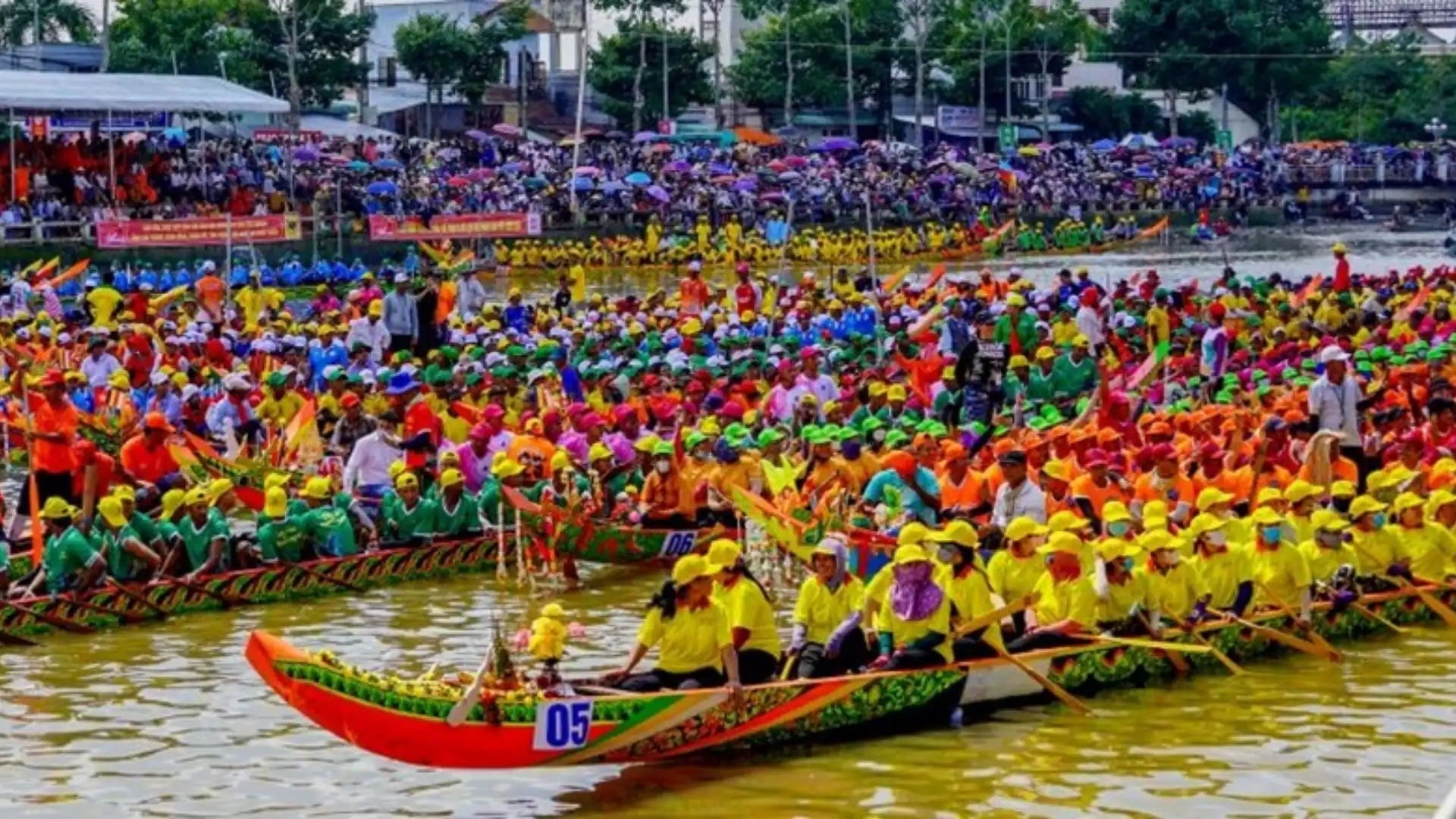
Ghe Ngo racing is especially associated with Ooc Om Boc, the Khmer Moon Worship Festival, traditionally observed around the full moon of the tenth lunar month.
The festival includes ceremonies expressing gratitude to the Moon and hopes for favorable weather, successful harvests and community well-being.
Boat racing is one of its most visible activities.
Teams representing Khmer pagodas and communities gather to compete on rivers, often attracting large crowds along the banks.
How do Ghe Ngo racing teams work together?
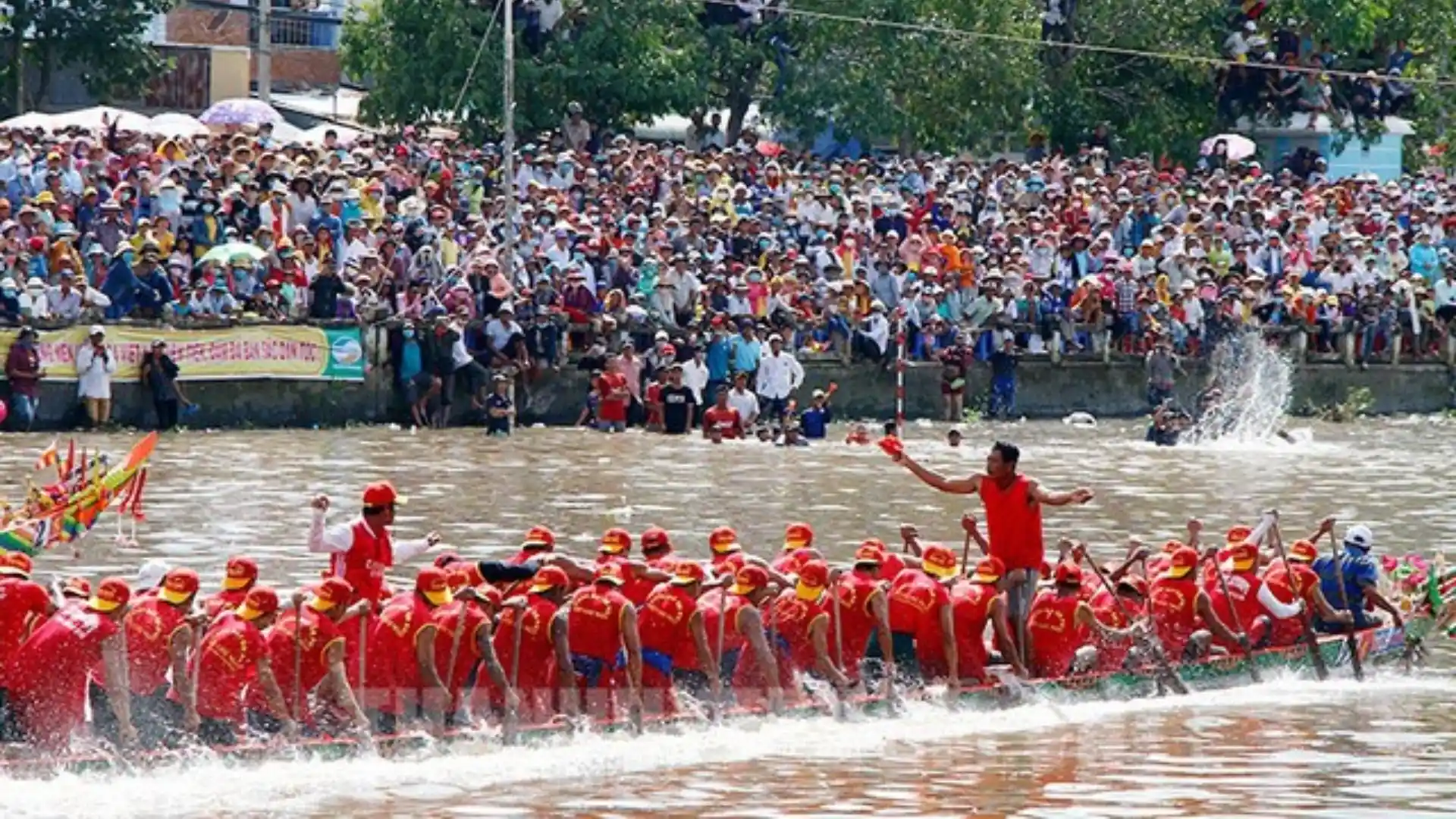
A Ghe Ngo can carry dozens of paddlers arranged along its narrow hull.
During a race, maintaining a coordinated rhythm is essential. The paddlers must respond to signals from experienced team members while keeping their strokes synchronized.
Traditional racing teams can include people responsible for setting the rhythm, directing the paddlers and steering from the rear.
The arrangement varies depending on the vessel and competition.
A fast boat therefore depends on more than its shape. Training, coordination and the crew’s ability to maintain a consistent rhythm are equally important.
Is Ghe Ngo racing a recognized cultural heritage?
Yes.
On January 12, 2022, Vietnam’s Ministry of Culture, Sports and Tourism included Ghe Ngo racing during the Khmer Ooc Om Boc Festival in the national intangible cultural heritage list under Decision No. 74/QĐ-BVHTTDL.
This recognition concerns the traditional racing practice and its cultural context. It does not mean that every individual Ghe Ngo has been separately designated as a protected heritage artifact.
The recognition reflects the importance of racing traditions in Khmer community life.
Where can visitors see a Ghe Ngo in the Mekong Delta?
Travelers can learn about Ghe Ngo culture by attending an organized race, visiting a museum or exploring Khmer cultural sites.
These experiences are different, and access depends on the venue and local arrangements.
Watch a Ghe Ngo race in the former Soc Trang area
The former Soc Trang area, now part of Can Tho City, is closely associated with major Ghe Ngo racing events.
The Maspéro River in Soc Trang Ward is a prominent venue, where decorated boats compete before crowds gathered along the riverbanks.
For 2026, the announced Ghe Ngo races are scheduled for November 23-24 on the Maspéro River. Visitors should confirm the latest program before traveling, as event arrangements may change.
For race schedules, venues and festival activities, see our Ooc Om Boc Festival 2026 guide.
What should you look for during a Ghe Ngo race?
Watching the details can make the experience more meaningful, especially for visitors unfamiliar with Khmer racing traditions.
- The boat’s animal symbols and colors
Look at the bow and the patterns along the hull. Different teams may display distinct animal figures or decorative designs associated with their pagodas.
- The paddling rhythm
Notice how pairs of paddlers work together. Their synchronized strokes and responses to signals are central to the boat’s movement.
- The people directing the crew
Depending on the team’s arrangement, you may see experienced members signaling a rhythm, giving instructions or steering the boat.
- The community behind each team
The athletes represent wider groups of supporters. Boat preparation, maintenance and participation often involve many people beyond the racing crew.
For a comfortable visit, arrive before the announced competition, follow crowd-control instructions and use designated spectator areas where provided.
Avoid entering team preparation zones or interfering with ceremonies.
Visit the Khmer Ethnic Culture Museum in Vinh Long
The Khmer Ethnic Culture Museum is located in Nguyet Hoa Ward, Vinh Long Province, within the former Tra Vinh area.
Situated near Ao Ba Om and Ang Pagoda, it provides opportunities to explore Khmer cultural heritage through historical objects and exhibitions.
The museum preserves the Ghe Ngo from Ba Si Pagoda described earlier in this article.
The vessel was transferred to the museum in 2021 for preservation and display.
Visitors interested in boatbuilding may find the documented timber construction, seating arrangement and decorative patterns especially informative.
Exhibition access and visiting arrangements should be confirmed before making a trip.
Explore Khmer Buddhist culture in Can Tho
Even when a racing boat is not available to view, Khmer pagodas provide important context for understanding the communities that maintain Ghe Ngo traditions.
Pothisomron Pagoda in O Mon Ward, Can Tho City, is one example of a historic Khmer Buddhist site where visitors can learn about religious architecture and cultural heritage.
However, it should not be presented as a confirmed Ghe Ngo viewing location.
Pagodas remain active religious spaces. Visitors should dress respectfully, ask permission before photographing ceremonies or worshippers, and follow any restrictions on access.
For a wider itinerary, our Mekong Delta travel guide covers destinations, regional geography and trip planning.
Planning Your Mekong Trip?
Get a free, personalized itinerary from our local experts in under 120 minutes.

Get a Free Consultation Leave your contact, we handle the rest.
Frequently asked questions about Ghe Ngo
What is a Ghe Ngo boat used for?
A Ghe Ngo is primarily used in traditional Khmer boat racing and related cultural ceremonies. It is not an ordinary passenger or sightseeing boat.
How long is a traditional Ghe Ngo?
Many Ghe Ngo boats are approximately 25-30 meters long, although dimensions vary. Preserved examples include a 25.6-meter boat from Tam Soc Pagoda and a 28-meter boat from Ba Si Pagoda.
How many people paddle a Ghe Ngo?
A Ghe Ngo typically carries several dozen paddlers, often around 40-60, but crew sizes differ between boats and competitions. Additional people may direct the rhythm or steer the vessel.
Is a Ghe Ngo the same as a dragon boat?
Both are long, team-paddled racing boats, and Ghe Ngo may sometimes be described as a Khmer dragon boat in English. However, Ghe Ngo belongs to a particular Khmer cultural tradition, with its own religious associations, decorative styles and community practices.
Can tourists ride a Ghe Ngo?
Ghe Ngo boats are not generally operated as regular tourist rides. Watching an authorized race or visiting a museum is a more reliable way to experience this tradition. Any opportunity to board a boat would require permission from its owners or organizers.
Understanding the culture behind the boat
A Ghe Ngo brings together several aspects of Khmer life in the Mekong Delta: woodworking traditions, spiritual beliefs, Buddhist pagoda communities and competitive sport.
Its decoration tells part of the story, but so do the people who maintain it, the ceremonies that accompany its use and the paddlers who return to train each racing season.
For travelers, understanding these connections adds meaning to the experience of watching the boats on the river.
If you are planning a wider cultural journey through Can Tho and the Mekong Delta, contact Mekong Smile for assistance with regional travel arrangements. Access to Ghe Ngo races, ceremonies and cultural sites remains subject to local organizers and current conditions.
