
 Can Tho
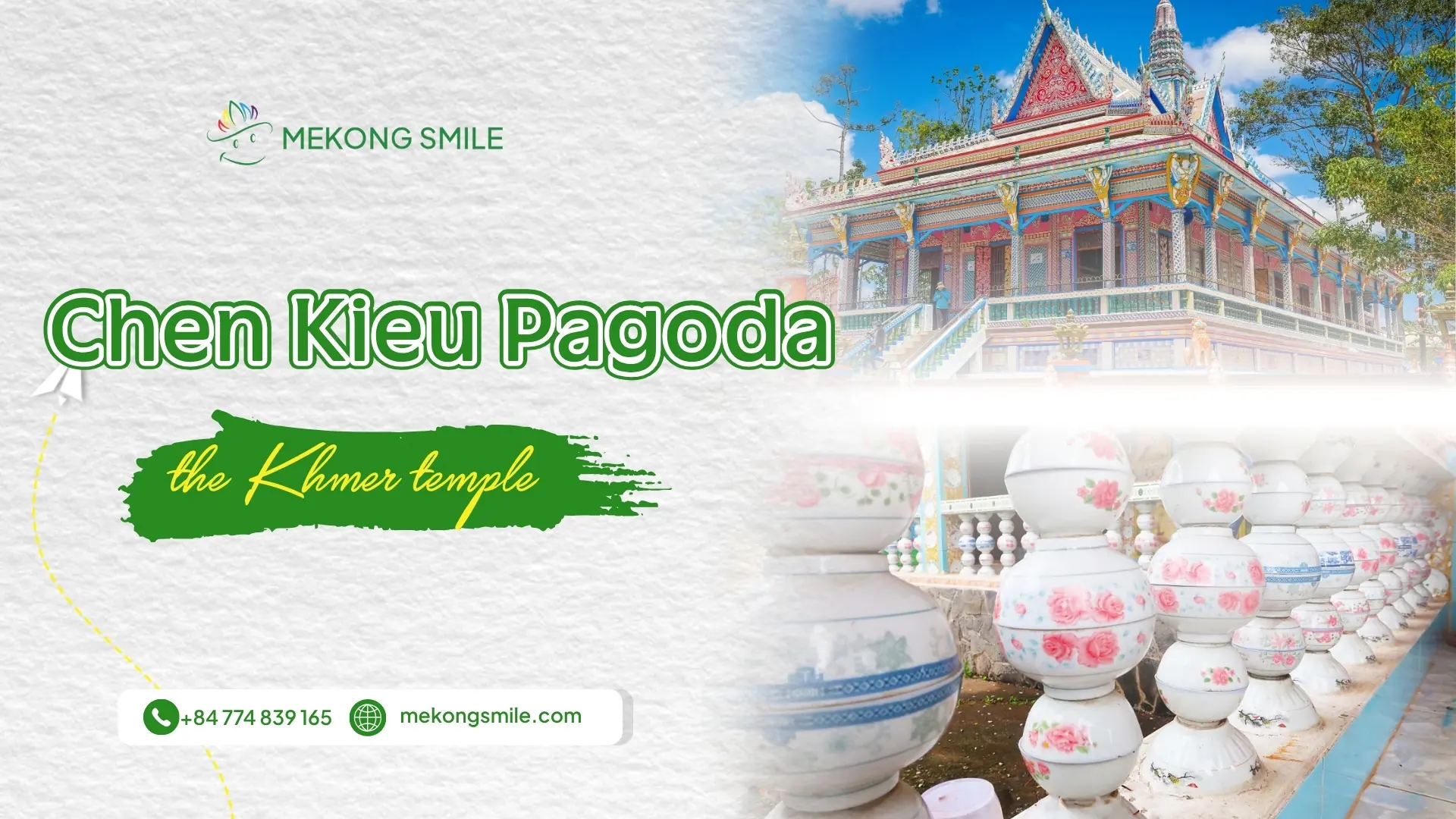
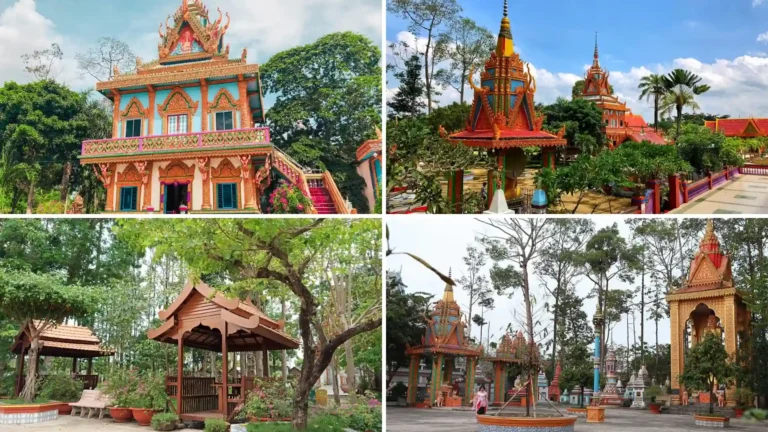
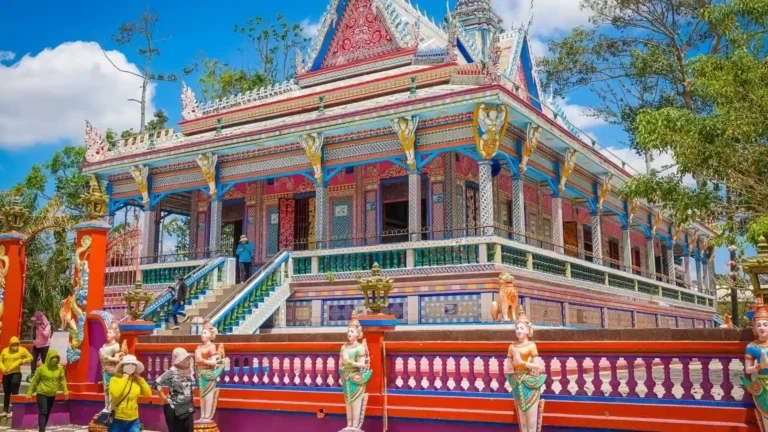
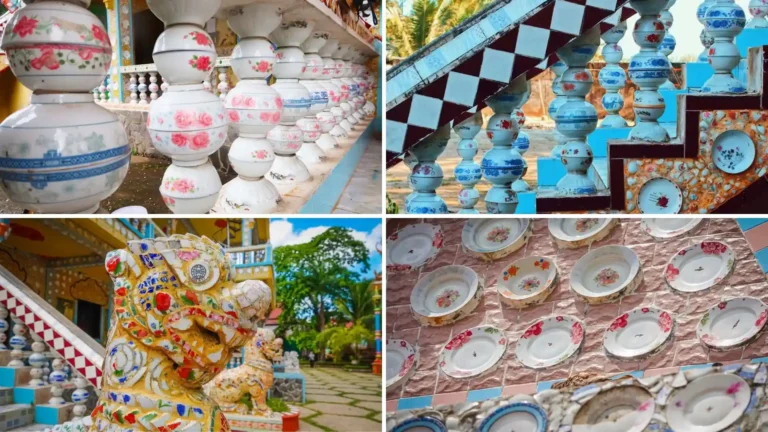
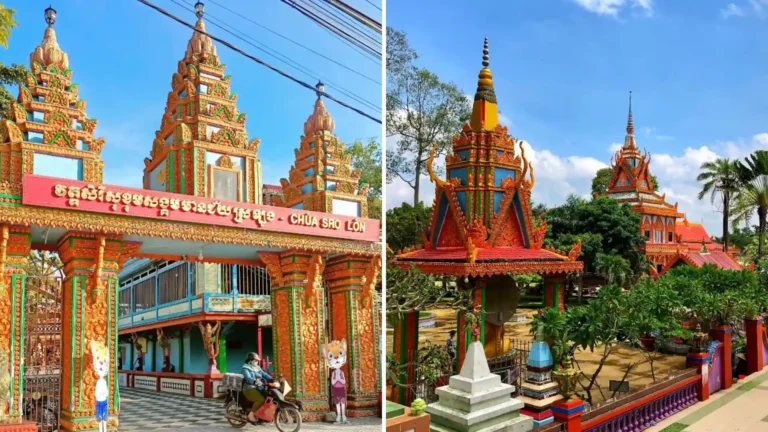

Along National Highway 1A in the former Soc Trang area, Chen Kieu Pagoda is immediately recognizable for its walls and columns decorated with ceramic bowls, plates, and porcelain fragments. Look closely, and you can see how everyday household objects have been arranged into colorful patterns across a Khmer Buddhist temple.
Also known as Sa Lon Pagoda or Wat Sro Loun, the pagoda has a history dating back to 1815. It remains an active place of worship for the local Khmer community, with architectural details and a collection of antique furniture that make it an interesting cultural stop in the Mekong Delta.
Although many travel guides still place the pagoda in Soc Trang Province, its current administrative location is My Xuyen Ward, Can Tho City, following Vietnam’s 2025 administrative changes.
Chen Kieu Pagoda at a glance
| Information | Details |
| Popular name | Chen Kieu Pagoda (Chùa Chén Kiểu) |
| Other names | Sa Lon Pagoda, Sro Loun Pagoda, Wat Sro Loun |
| Location | National Highway 1A, My Xuyen Ward, Can Tho City, Vietnam |
| Former address | Dai Tam Commune, My Xuyen District, Soc Trang Province |
| Religion | Khmer Theravada Buddhism |
| Founded | 1815 |
| Heritage recognition | Provincial-level architectural and artistic relic (2012) |
| Opening hours | Listed as 6:00 AM-6:00 PM daily; access to individual buildings may vary |
| Entrance fee | Free admission; voluntary donations are welcome |
| Suggested visit duration | 45-90 minutes |
| Main highlights | Porcelain mosaics, Khmer sculptures, Buddhist murals, Naga flagpole, and antique furniture |
| Google Maps | Sro Loun Pagoda (Chen Kieu Pagoda) |
The pagoda stands approximately 12 km from the former Soc Trang city center, along the highway toward Bac Lieu. It is considerably farther from central Can Tho, so travelers staying around Ninh Kieu Wharf should plan it as part of a longer road journey.
Why is Chen Kieu Pagoda decorated with bowls and plates?
The porcelain decorations at Chen Kieu Pagoda have their origins in the temple’s reconstruction. With limited building resources, local residents and Buddhist followers contributed bowls, plates, and other ceramic objects that craftsmen could reuse.
Some pieces were embedded largely intact, while broken fragments were arranged into decorative patterns across the walls, columns, and stairways. This distinctive use of ceramics gave rise to the Vietnamese name Chua Chen Kieu, referring to the patterned bowls incorporated into the architecture.
Beyond their visual appeal, the mosaics reflect the contributions of the local community. Everyday household objects became lasting features of a temple that continues to serve Khmer Buddhist worshippers.
What to see at Chen Kieu Pagoda
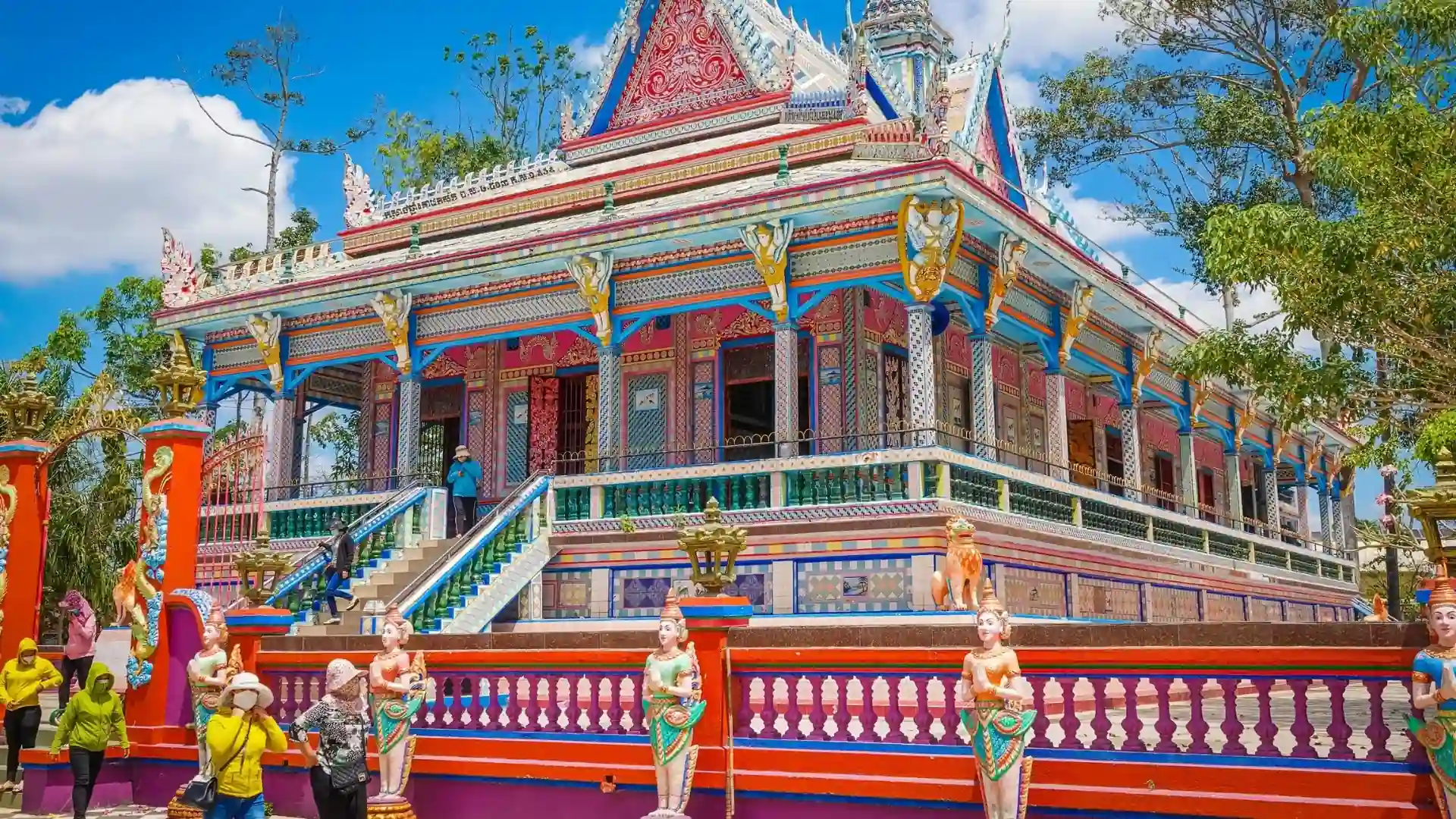
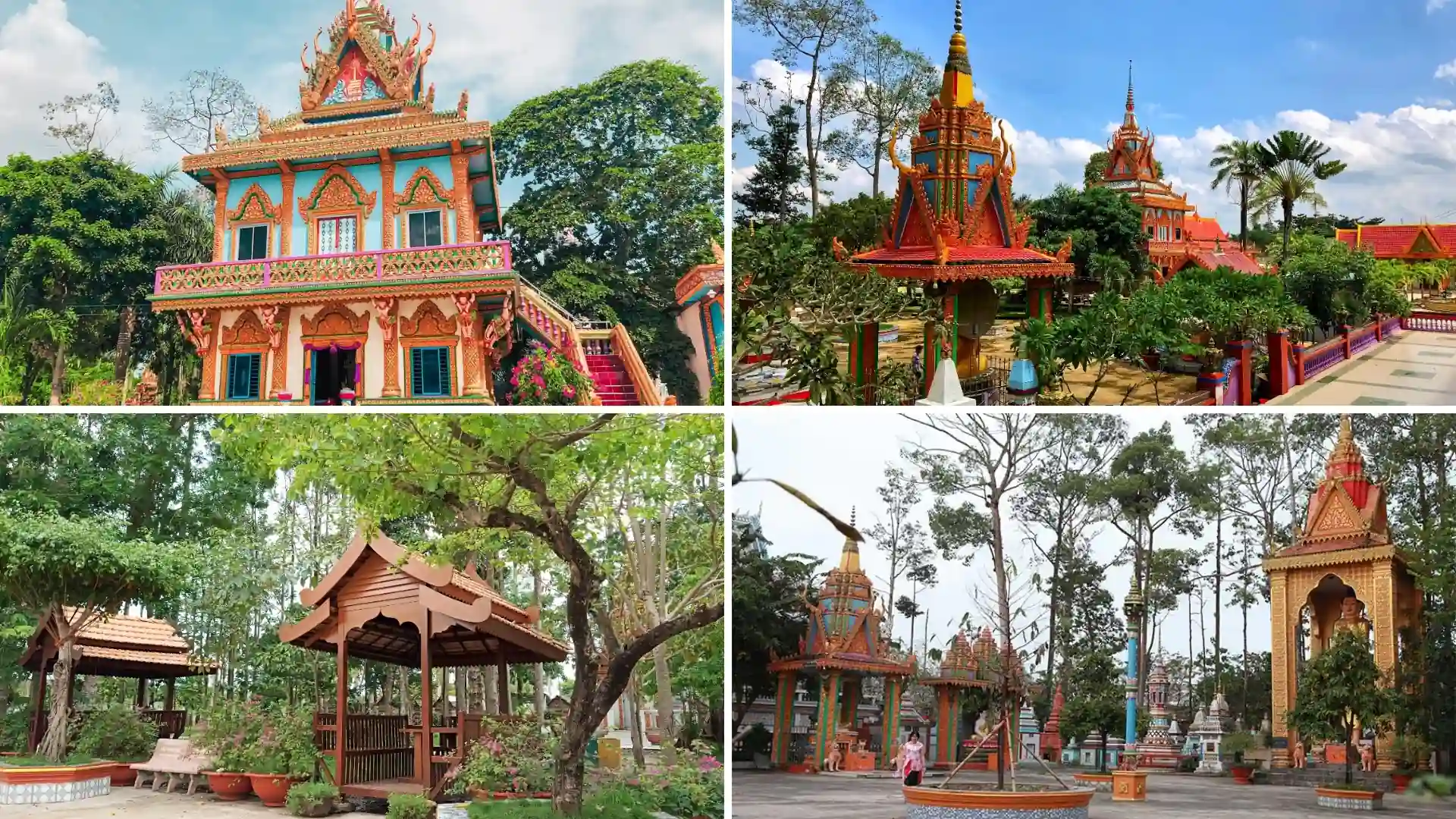
There is more to Chen Kieu Pagoda than its porcelain-covered exterior. The grounds contain traditional Khmer architectural features, Buddhist artwork, and historical objects associated with the former Soc Trang area.
The porcelain mosaics and ceramic decorations
Look closely at the walls and columns around the main buildings, where complete porcelain plates sit alongside smaller ceramic fragments. Floral designs, glazed surfaces, and geometric arrangements create patterns that vary across the temple.
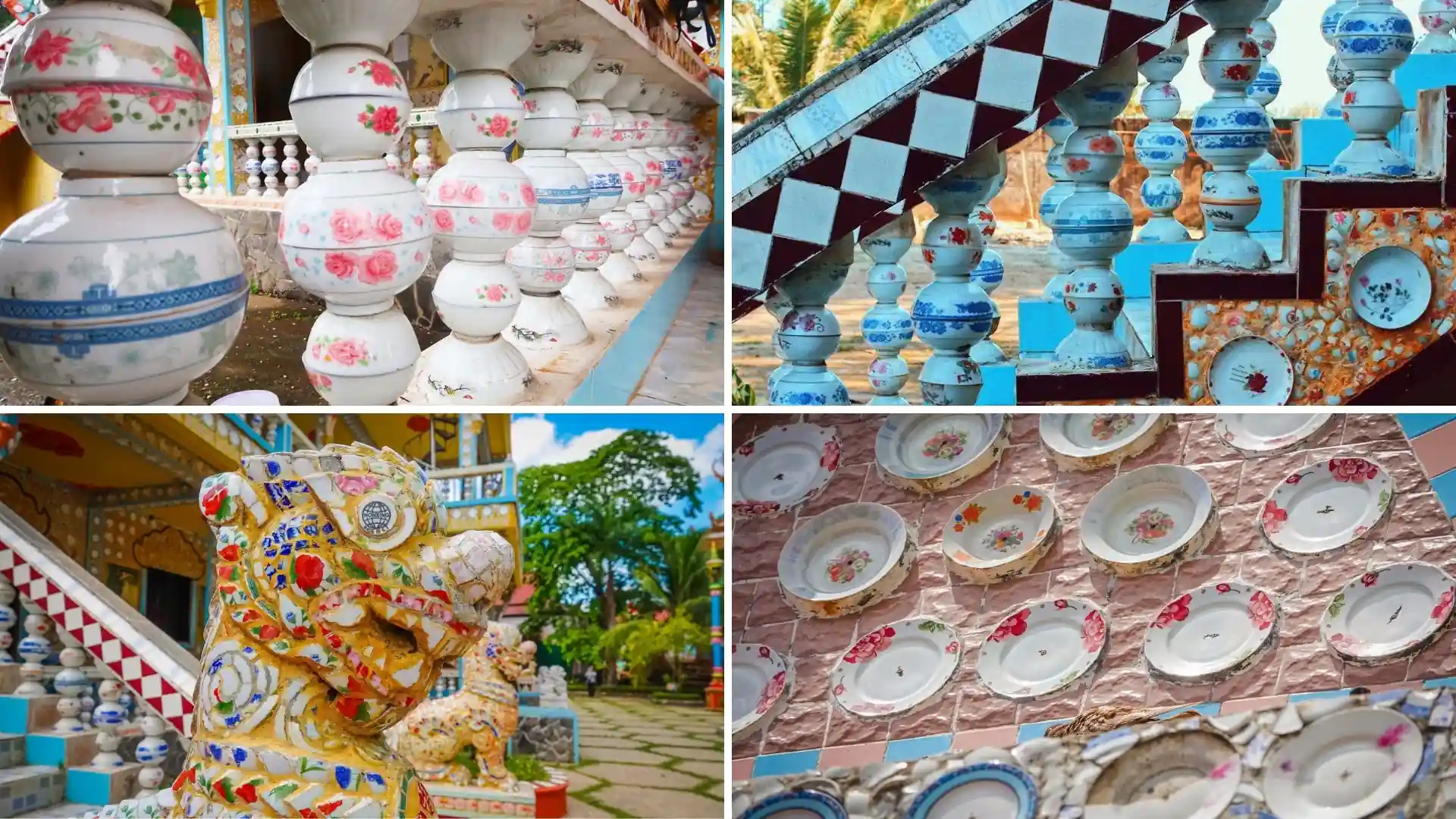
The stairways and railings also feature ceramic decorations, with bowls and plates incorporated into the architectural details. Rather than viewing the buildings only from a distance, take time to notice the individual pieces and how they fit together.
These decorative surfaces are part of the temple’s architecture, so visitors should avoid touching or leaning against them.
The entrance gate and Kerno sculptures
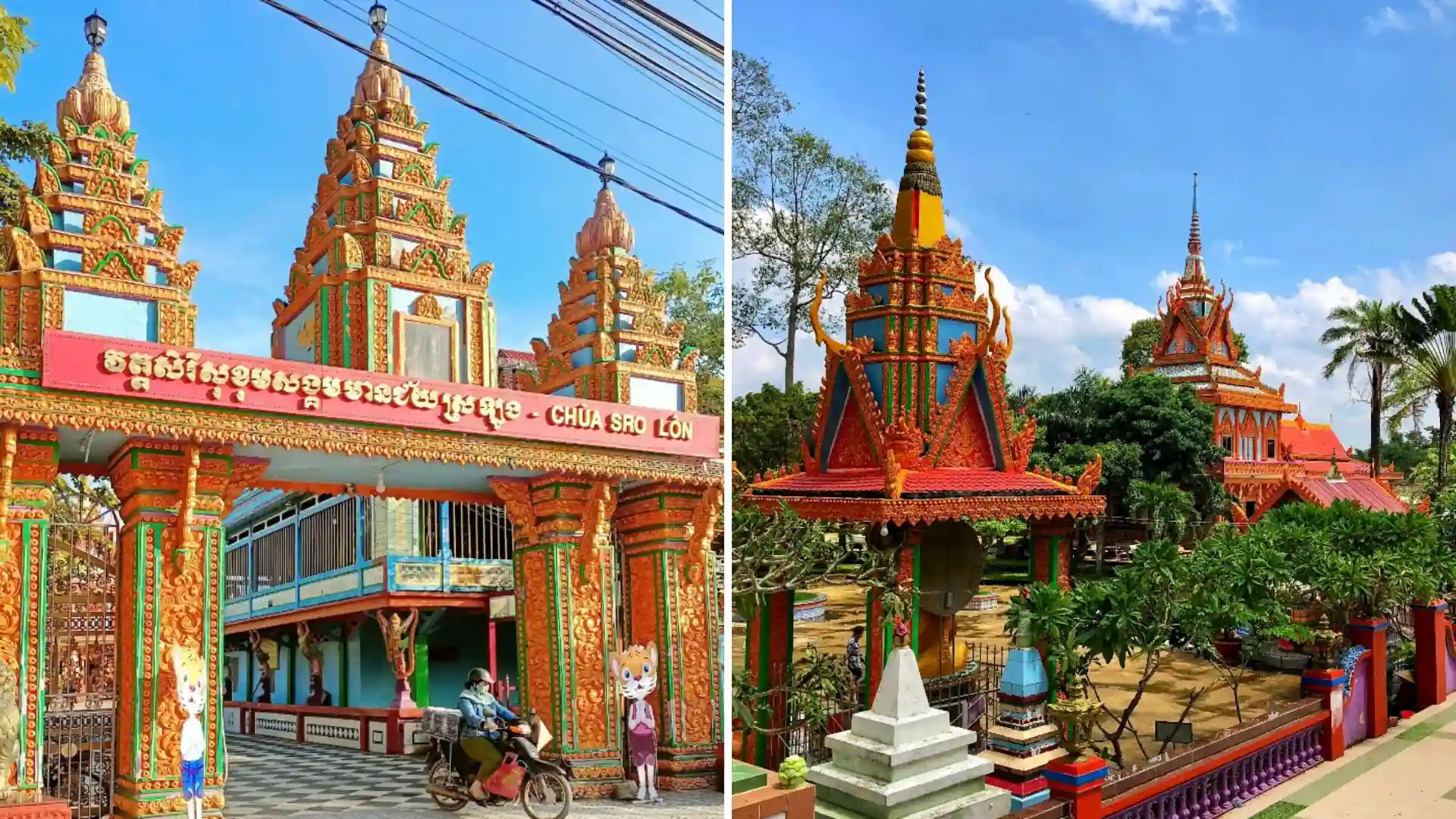
Chen Kieu Pagoda’s entrance gate introduces visitors to the artistic traditions of Khmer Buddhist architecture.
The three-entrance structure is topped by three decorated towers. The central tower contains a seated Buddha statue displayed within a glass enclosure.
Colorful patterns cover the gate, while decorative figures appear along the surrounding fence and the approach to the temple.
Among the most recognizable sculptures are Kerno figures, combining the face of a celestial dancer with birdlike features associated with Garuda in Khmer mythology.
Similar figures appear around the main sanctuary, where their outstretched wings and raised arms seem to support parts of the roof.
These sculptures are worth examining alongside the porcelain decorations. They show how traditional Khmer religious imagery and the temple’s distinctive ceramic craftsmanship coexist within the same complex.
The main sanctuary and Buddhist murals
The main sanctuary is the religious center of Chen Kieu Pagoda.
Its roof follows a tiered Khmer architectural design, with three levels that become progressively smaller toward the top. Decorative patterns, sculpted figures, and pointed architectural features give the building its recognizable appearance.
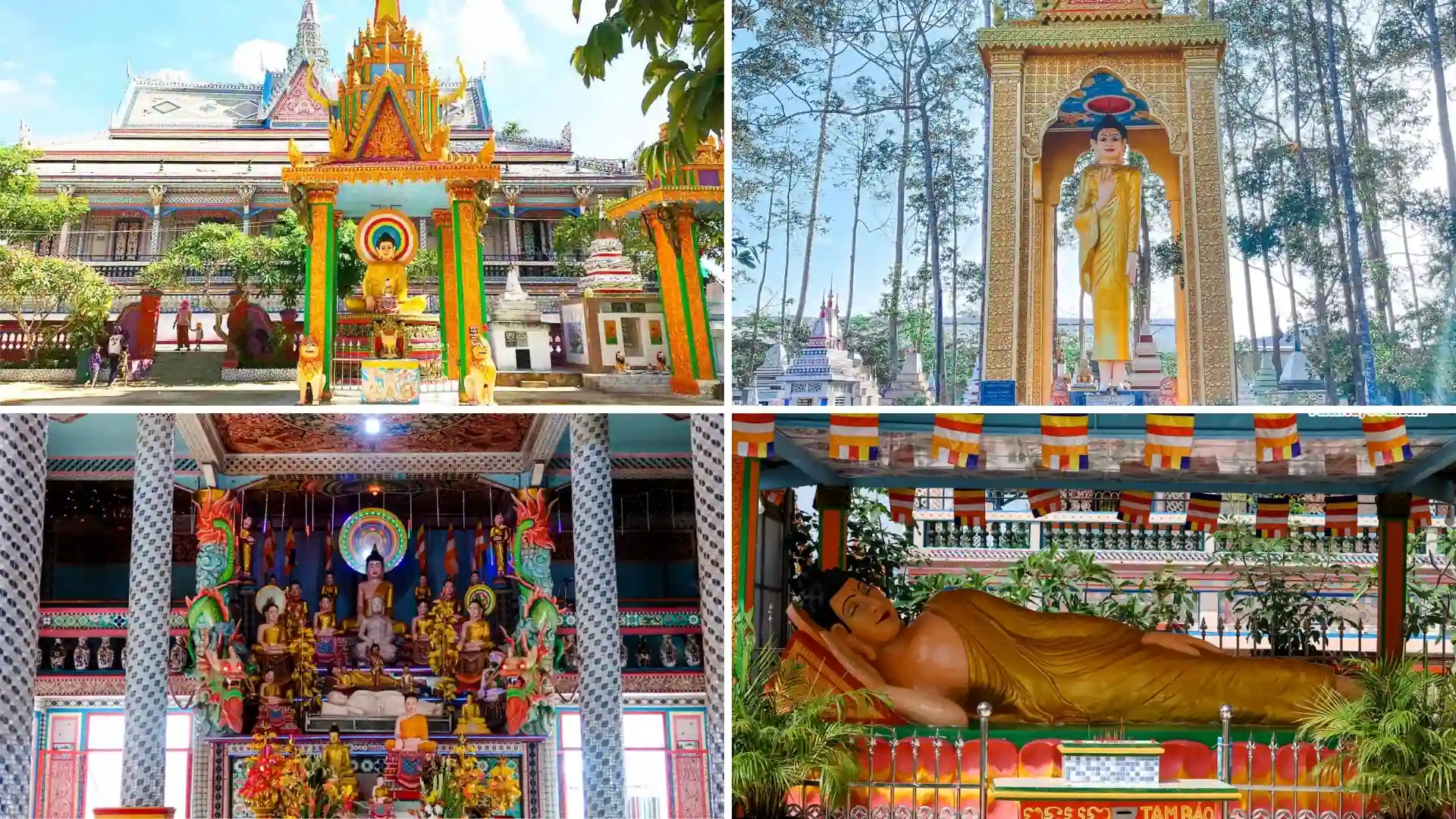
Inside, the sanctuary contains a collection of Buddha statues in standing, seated, and reclining postures.
Paintings on the interior walls depict episodes from the life of Shakyamuni Buddha, including his birth and enlightenment.
The columns are decorated with sculpted Kerno figures, while other details draw on Khmer mythology and Buddhist artistic traditions.
Because the sanctuary remains a place of worship, visitors should follow the instructions of monks or temple representatives. Entry and indoor photography may be restricted during religious activities.
The five-headed Naga flagpole and Buddha garden
In the courtyard stands a ceremonial flagpole decorated with the image of a five-headed Naga serpent.
The Naga is a recurring figure in Khmer Buddhist art. Its protective symbolism is associated with a Buddhist story in which a serpent shelters the Buddha during meditation.
At Chen Kieu Pagoda, the five-headed sculpture is an important decorative feature of the courtyard.
Behind the main sanctuary, a garden of Buddhist sculptures illustrates episodes from the life of Shakyamuni Buddha, from his birth through important stages of his spiritual journey.
The statues give visitors another way to understand the religious stories represented in the temple’s artwork.
Together, the flagpole and garden offer a different perspective on the pagoda beyond its porcelain mosaics.
The antique furniture associated with the Bac Lieu Prince
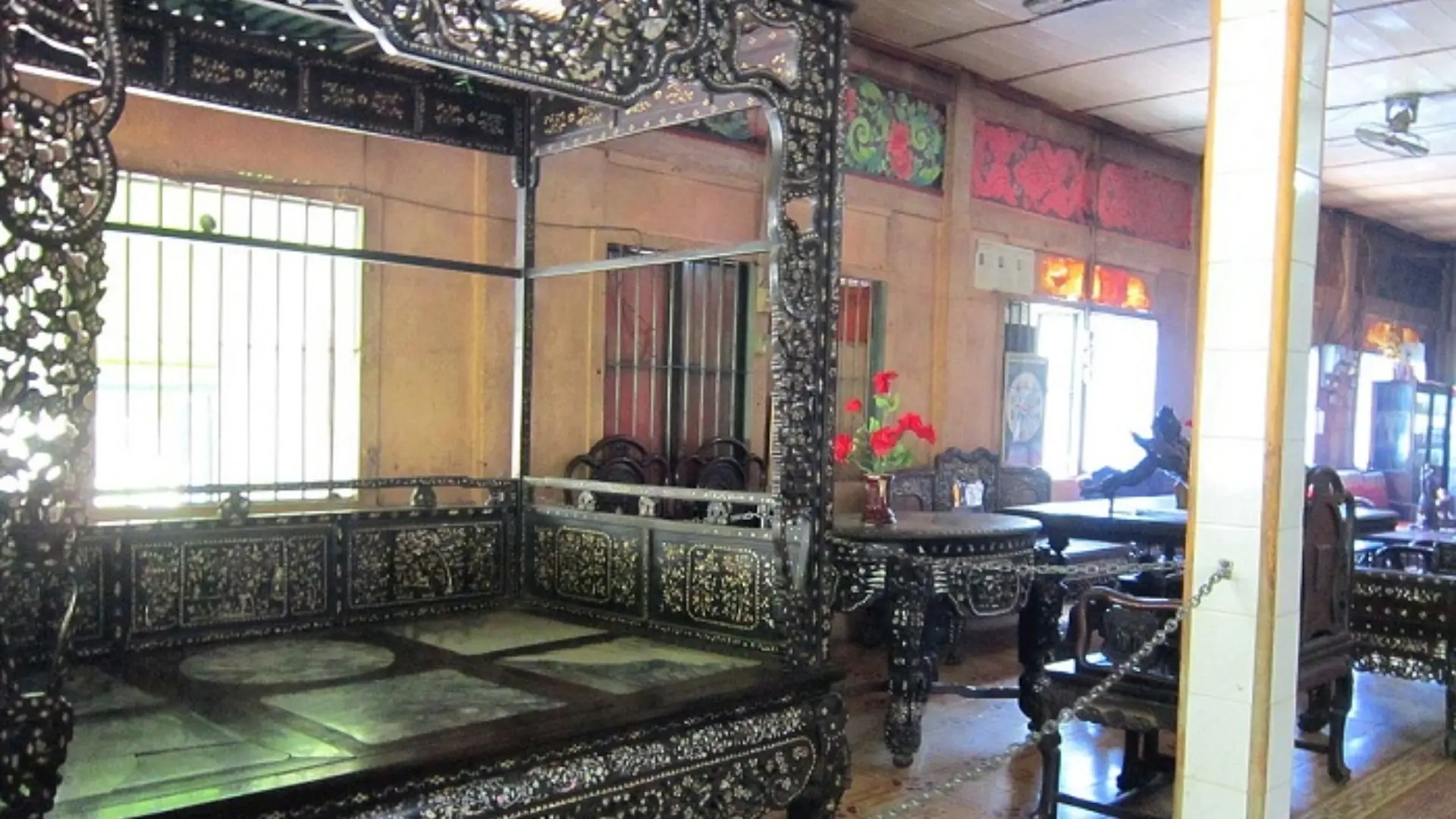
Another notable feature of Chen Kieu Pagoda is its collection of antique furniture associated with the family of Tran Trinh Huy, widely known as Cong tu Bac Lieu, or the Bac Lieu Prince.
The collection includes intricately carved wooden furniture and two unusual beds traditionally described as the “hot” and “cool” beds. One features a wooden sleeping surface, while the other has a stone surface designed to feel cooler in warm weather.
According to historical accounts, the pagoda purchased these furnishings from people connected to the Bac Lieu Prince’s family. The reported acquisition dates differ between sources, but the objects remain an interesting connection to the social history of southern Vietnam.
Visitors interested in the collection should check which items are accessible during their visit, as display arrangements may change.
The history of Chen Kieu Pagoda
Chen Kieu Pagoda was originally established in 1815, when its buildings were constructed using relatively simple materials, including timber and leaves.
Over time, the original structures deteriorated and the pagoda underwent several phases of reconstruction.
According to a March 2026 report by Thanh Nien Newspaper, Venerable Tang Duch organized rebuilding work in 1945 with contributions from local residents and Buddhist followers.
Vietnam’s national tourism database describes a major rebuilding phase beginning in 1969 and reaching completion in 1980. Thanh Nien also records further improvements undertaken under Venerable Quach Men after 1985, with additional work completed in 1989.
These successive construction efforts helped shape the temple complex seen today.
The use of ceramic bowls and plates became a defining part of the rebuilt architecture. What began as a practical way to make use of available materials developed into a distinctive form of decoration associated with the temple.
In 2012, Chen Kieu Pagoda was recognized as a provincial-level historical and cultural relic.
Today, the pagoda continues to serve the local Khmer Theravada Buddhist community as a place of worship and cultural connection.
Its significance lies not only in the age of the temple or the unusual decoration, but also in the generations of people who contributed to its preservation.
How to get to Chen Kieu Pagoda
Chen Kieu Pagoda is located beside National Highway 1A in My Xuyen Ward, Can Tho City.
Its former address was Dai Tam Commune, My Xuyen District, Soc Trang Province. You may still see this older address on travel websites, maps, and tour itineraries.
From central Can Tho
Travelers staying near Ninh Kieu Wharf or in central Can Tho will need to travel south toward the former Soc Trang area.
A private car or prearranged road transfer is a practical option, particularly if you plan to visit several cultural sites in the same region.
The pagoda is not within the central Ninh Kieu sightseeing area, so it should not be treated as a short city-center stop.
Check the route and estimated travel time before departure, especially when planning to return to Can Tho on the same day.
Google Maps directions from Ninh Kieu Wharf to Chen Kieu Pagoda
From the former Soc Trang city center
Chen Kieu Pagoda is approximately 12 km from the former Soc Trang city center, in the direction of Bac Lieu along National Highway 1A.
Travelers can reach the pagoda by car or motorbike, following the highway toward My Xuyen.
This location makes the temple a practical stop when traveling through the former Soc Trang area rather than visiting only central Can Tho.
For navigation, search for Chùa Chén Kiểu or Sro Loun Pagoda on Google Maps.
When to visit Chen Kieu Pagoda
For sightseeing, the morning and late afternoon are generally more comfortable than the hottest hours around midday.
Natural light also makes it easier to see the colors and patterns of the porcelain decorations.
The current map listing gives opening hours of 6:00 AM-6:00 PM daily. However, this should not be interpreted as a guarantee that every part of the temple, including the main sanctuary or antique displays, is accessible throughout that period.
A visit of around 45-90 minutes is a reasonable planning allowance if you want to examine the architectural details, walk around the grounds, and visit the areas open to the public.
Weekends, festivals, and major Buddhist observances may attract more people. Traffic can also become heavier along National Highway 1A during busy periods.
If you are visiting as part of a longer journey, allow some flexibility rather than scheduling your next stop immediately afterward.
Practical tips for visiting Chen Kieu Pagoda
Chen Kieu Pagoda is an active Buddhist temple, so respectful behavior is important throughout the visit.
Clothing: Wear modest clothing that covers your shoulders and knees. Follow any instructions about removing shoes before entering religious spaces.
Photography: The exterior architecture and ceramic details provide interesting photographic subjects. Ask permission before taking photographs inside the main sanctuary or photographing monks and worshippers.
Temple etiquette: Speak quietly, avoid interrupting ceremonies, and do not touch sacred objects, porcelain mosaics, or antique furniture.
Weather: Bring drinking water and sun protection, especially when visiting during warmer parts of the day.
Parking and roadside traffic: Follow current parking instructions rather than stopping directly in front of the pagoda along the highway.
Donations: Admission is generally free. Visitors who wish to support the temple may make a voluntary donation through the appropriate channels.
Is Chen Kieu Pagoda worth visiting?
Chen Kieu Pagoda is particularly interesting for travelers who enjoy religious architecture, Khmer culture, and local history.
Its porcelain mosaics are the main attraction. Instead of simply admiring a colorful temple, visitors can examine how bowls, plates, and ceramic fragments have been incorporated into the buildings.
The Kerno sculptures, Buddhist murals, five-headed Naga flagpole, and antique furniture provide additional reasons to explore the grounds.
The pagoda makes the most sense as part of a journey through the former Soc Trang area, especially for travelers interested in the Khmer heritage of southern Vietnam.
If you are staying in central Can Tho with only a few hours available, consider the additional road travel before deciding to make a separate trip.
For Khmer Buddhist architecture closer to central Can Tho, Pitu Khosa Rangsay Pagoda offers a different setting. Pothisomron Pagoda in O Mon is another place to explore Khmer religious history.
You can also discover Phu Ly 1 Pagoda in Vinh Long, known for its golden sanctuary, elaborate sculptures, and ceremonial flagpole. Its architectural character differs from Chen Kieu’s porcelain-covered buildings.
For travelers planning a wider cultural journey, the Mekong Delta travel guide provides additional information about destinations, transport, and regional travel planning.
Frequently asked questions about Chen Kieu Pagoda (FAQ)
Where is Chen Kieu Pagoda located?
Chen Kieu Pagoda is located on National Highway 1A in My Xuyen Ward, Can Tho City, Vietnam. It was formerly part of Dai Tam Commune, My Xuyen District, Soc Trang Province.
Why is Chen Kieu Pagoda famous?
The pagoda is known for its decorations made from ceramic bowls, plates, and porcelain fragments. These materials were used during reconstruction and became its most distinctive architectural feature.
Is Chen Kieu Pagoda free to visit?
Yes. Admission is generally free, and visitors may make voluntary donations. Parking or other services, where applicable, may have separate charges.
What are the opening hours of Chen Kieu Pagoda?
The current map listing shows 6:00 AM-6:00 PM daily. Access to individual buildings may vary, particularly during religious activities.
How long does it take to visit Chen Kieu Pagoda?
Allow approximately 45-90 minutes for a relaxed visit. The actual time depends on which areas are accessible and your interest in the architecture and historical objects.
Is Chen Kieu Pagoda in Soc Trang or Can Tho?
Chen Kieu Pagoda was formerly in Soc Trang Province. Following the 2025 administrative changes, it is now part of Can Tho City. Its physical location has not changed.
Explore Khmer heritage in the Mekong Delta
Chen Kieu Pagoda offers a closer look at Khmer Buddhist heritage through its porcelain mosaics, religious artwork, and historical objects. It is a cultural stop worth considering when exploring the former Soc Trang area.
Planning a longer journey through the Mekong Delta? Contact Mekong Smile to discuss your travel dates, starting point, and the places you would like to visit.
Planning Your Mekong Trip?
Get a free, personalized itinerary from our local experts in under 120 minutes.

Get a Free Consultation Leave your contact, we handle the rest.
