
 Can Tho
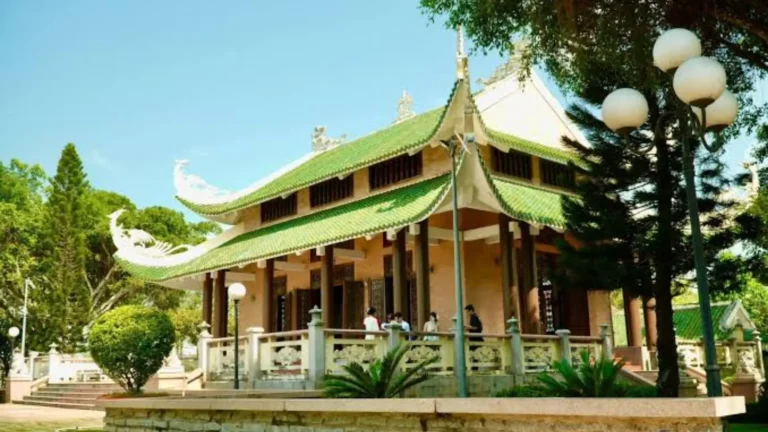

About 5 km from central Can Tho, Bui Huu Nghia Memorial (Khu tưởng niệm Thủ khoa Bùi Hữu Nghĩa) stands around the tomb of a 19th-century Vietnamese scholar, poet, and government official. His life is remembered through both his literary achievements and accounts of his efforts to defend ordinary people against injustice.
Located in Bình Thủy, the memorial brings together a nationally recognized historic tomb, traditional-style architecture, a worship hall, and exhibits about the man known as Thủ khoa Nghĩa.
Admission is free, some information is available in English, and most visitors can explore the grounds in 30-60 minutes. It’s a worthwhile addition to a Bình Thủy heritage outing, particularly for travelers interested in the history of southern Vietnam.
Bui Huu Nghia Memorial at a Glance
| Visitor Information | Details |
|---|---|
| Vietnamese name | Khu tưởng niệm Thủ khoa Bùi Hữu Nghĩa |
| Historic site | Mộ Thủ khoa Bùi Hữu Nghĩa (Bui Huu Nghia Tomb) |
| Address | Huỳnh Mẫn Đạt Street, Bình Thủy Ward, Can Tho, Vietnam |
| Google Maps | https://maps.app.goo.gl/yWqX2k4qa9RsuesA6 |
| Distance from central Can Tho | Approximately 5 km |
| Morning hours | 7:30 AM-10:30 AM |
| Afternoon hours | 1:30 PM-4:30 PM |
| Admission | Free |
| Suggested visit | 30-60 minutes |
| English information | Available for some exhibits and visitor materials |
| National historical recognition | January 25, 1994 |
| Expanded memorial inaugurated | March 1, 2013 |
| Main attractions | Historic tomb, memorial hall, commemorative stele, exhibition area, and gardens |
Planning tip: The memorial has separate morning and afternoon visiting sessions, with a three-hour midday closure. Arriving before 10 AM or early in the afternoon gives you more flexibility to explore.
The History Behind Bui Huu Nghia Memorial
The memorial is dedicated to Bùi Hữu Nghĩa (1807-1872), a respected scholar and writer who served as an official under Vietnam’s Nguyễn Dynasty.
To understand why he is remembered today, it helps to know something about the society in which he lived. In 19th-century Vietnam, education in Confucian classics and success in imperial examinations were important paths into government service. Scholars who became officials were expected to uphold moral principles as well as carry out administrative responsibilities.
Bùi Hữu Nghĩa’s life illustrates both the opportunities and difficulties of that system.
Who Was Bui Huu Nghia?
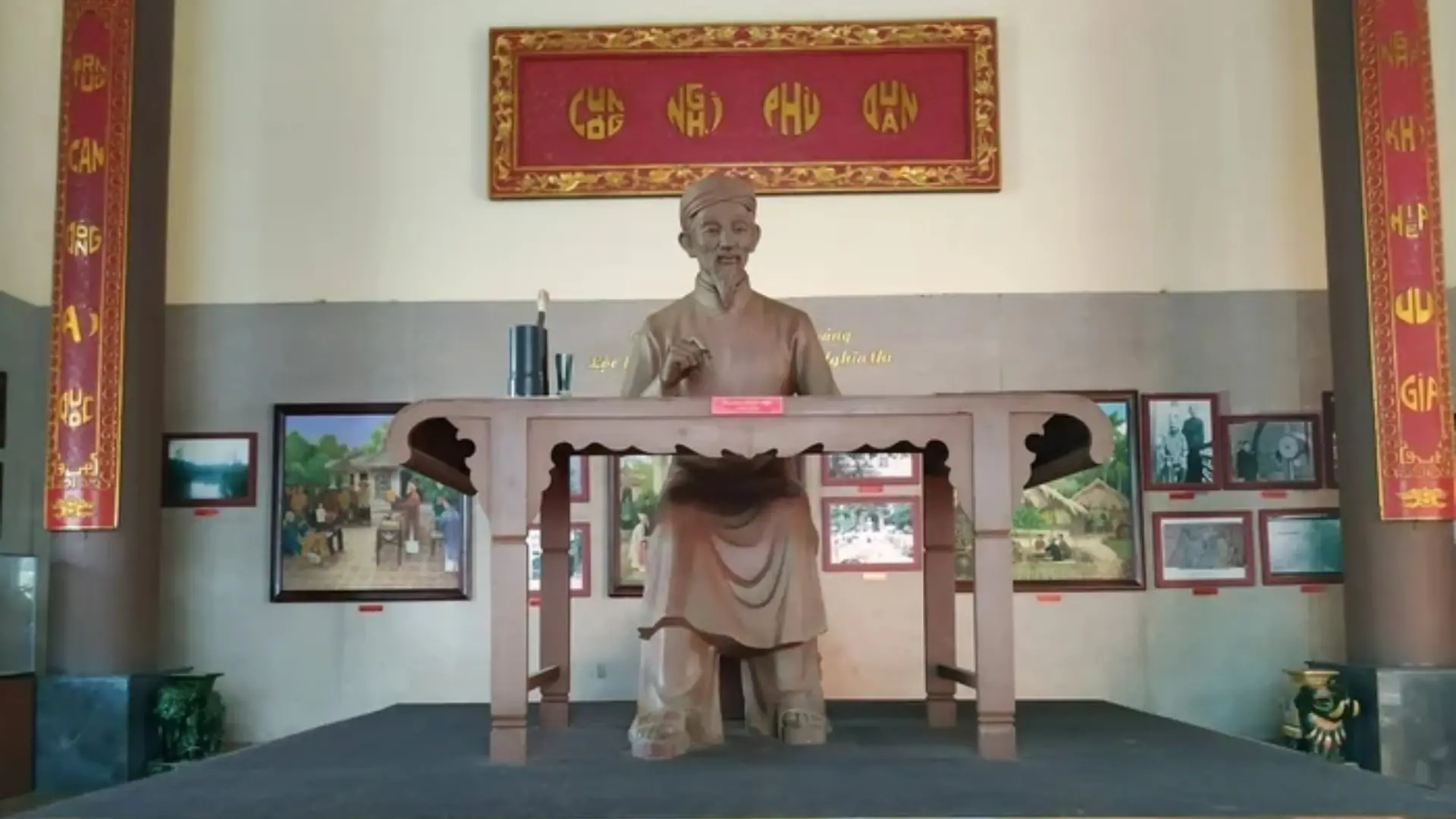
Bùi Hữu Nghĩa, also known by his literary name Nghi Chi, was born in 1807 in the Bình Thủy area, in a family whose livelihood was connected to fishing.
He pursued a traditional scholarly education and, in 1835, achieved first place in the regional imperial examination (thi Hương) held at Gia Định.
The highest-ranking candidate received the distinction of Giải nguyên. In southern Vietnam, this achievement was commonly associated with the title Thủ khoa, meaning the leading examination candidate.
That is how Bùi Hữu Nghĩa became widely known as Thủ khoa Nghĩa.
His examination success led to appointments under the Nguyễn Dynasty, including positions associated with Phước Chánh in Biên Hòa and Trà Vang, an area historically connected with present-day Trà Vinh.
His government career, however, was marked by conflict. The most widely remembered episode concerns a dispute over fishing rights at Rạch Láng Thé, where his decisions reportedly brought him into opposition with powerful local interests.
The Lang The Dispute and Nguyen Thi Ton’s Petition
The story of Rạch Láng Thé (Láng Thé Canal) remains one of the most significant episodes associated with Bùi Hữu Nghĩa.
The dispute took place in the Trà Vang area, where waterways provided food, transportation, and livelihoods for local communities, including Khmer residents.
According to local historical accounts, a conflict developed over the right to collect revenue from fishing and other aquatic resources. Bùi Hữu Nghĩa defended residents who opposed these demands, bringing him into conflict with influential officials.
The accounts describe a violent confrontation, followed by accusations against Bùi Hữu Nghĩa that placed him under a death sentence.
His wife, Nguyễn Thị Tồn, became central to the story.
She reportedly traveled from southern Vietnam to the imperial capital of Huế to petition the royal court on her husband’s behalf. Her efforts helped secure a reprieve, although he was subsequently required to serve in a frontier military posting at Vĩnh Thông, near Châu Đốc.
The account has been preserved through family recollections, local histories, and later biographical writing. Researchers have also identified differences among these sources, particularly concerning the chronology and the officials involved.
These uncertainties matter when reading the story as history. They do not, however, diminish the importance of the episode in local remembrance.
For generations, the Láng Thé affair has shaped the image of Bùi Hữu Nghĩa as an official willing to challenge injustice, while Nguyễn Thị Tồn has been remembered for her determination to defend her husband.
Readers interested in the historical evidence can consult the detailed examination published by Báo Thanh Niên on December 15, 2023, which compares accounts of the dispute and discusses unresolved details.
His Literary Legacy and Kim Thach Ky Duyen
Bùi Hữu Nghĩa was also a poet and playwright whose work contributed to the literary culture of southern Vietnam.
He is traditionally celebrated as one of the Four Golden Dragons, a name associated with distinguished literary figures of the historical southern region.
His best-known dramatic work is Kim Thạch kỳ duyên, written in the tradition of hát bội, also known as tuồng.
Hát bội is a form of Vietnamese classical theater characterized by stylized acting, music, elaborate costumes, and poetic dialogue. Its stories often explore loyalty, justice, family obligations, and moral conflict.
Kim Thạch kỳ duyên draws on an earlier Chinese literary narrative, but Bùi Hữu Nghĩa adapted the material into a Vietnamese theatrical work. Scholars have examined how he reshaped the source through language, characterization, and dramatic conventions.
The work holds an important place in the literary history of Vietnamese traditional theater, particularly in southern Vietnam.
During his later years, Bùi Hữu Nghĩa returned to the Long Tuyền area of Can Tho. Local biographies record that he taught students, wrote poetry, and practiced traditional medicine.
He died in 1872, leaving behind a reputation rooted in scholarship, public service, and literature.
How the Historic Tomb Became a Memorial Complex
The origins of the present memorial lie in Bùi Hữu Nghĩa’s burial site.
After his death, residents of Bình Thủy continued to honor him. His tomb, historically built with laterite stone, was maintained and restored by successive generations.
On January 25, 1994, the tomb, officially known as Mộ Thủ khoa Bùi Hữu Nghĩa, was recognized as a national historical relic by Vietnam’s Ministry of Culture and Information.
The site later underwent a major expansion.
In 2009, Can Tho began developing a larger memorial around the existing burial grounds. The project added ceremonial buildings, exhibition facilities, and landscaped areas, creating a complex covering approximately 10,000 square meters.
The expanded memorial was officially inaugurated on March 1, 2013.
This distinction is important for visitors: the nationally recognized historical site is Bùi Hữu Nghĩa’s tomb, while much of the surrounding architecture belongs to the memorial development completed in 2013.
The new buildings use traditional Vietnamese design, but they are not structures preserved unchanged from the 19th century.
What to See at Bui Huu Nghia Memorial
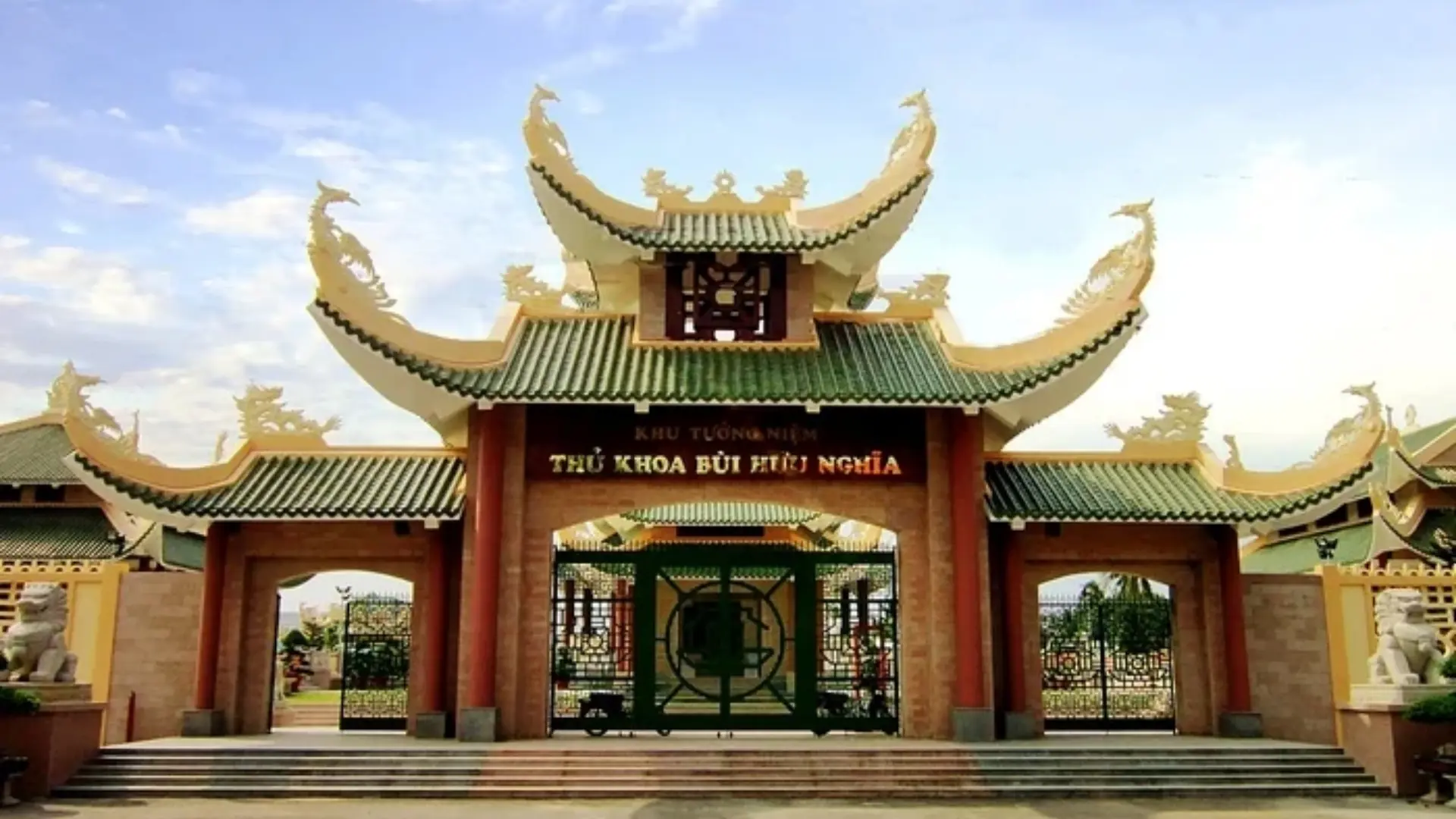
The memorial is arranged around several ceremonial buildings and the historic tomb. The grounds are spacious enough for a relaxed visit without requiring an entire morning or afternoon.
Start at the entrance and commemorative stele, continue into the central hall, and then explore the exhibition area and tomb.
The Entrance Gate and Commemorative Stele
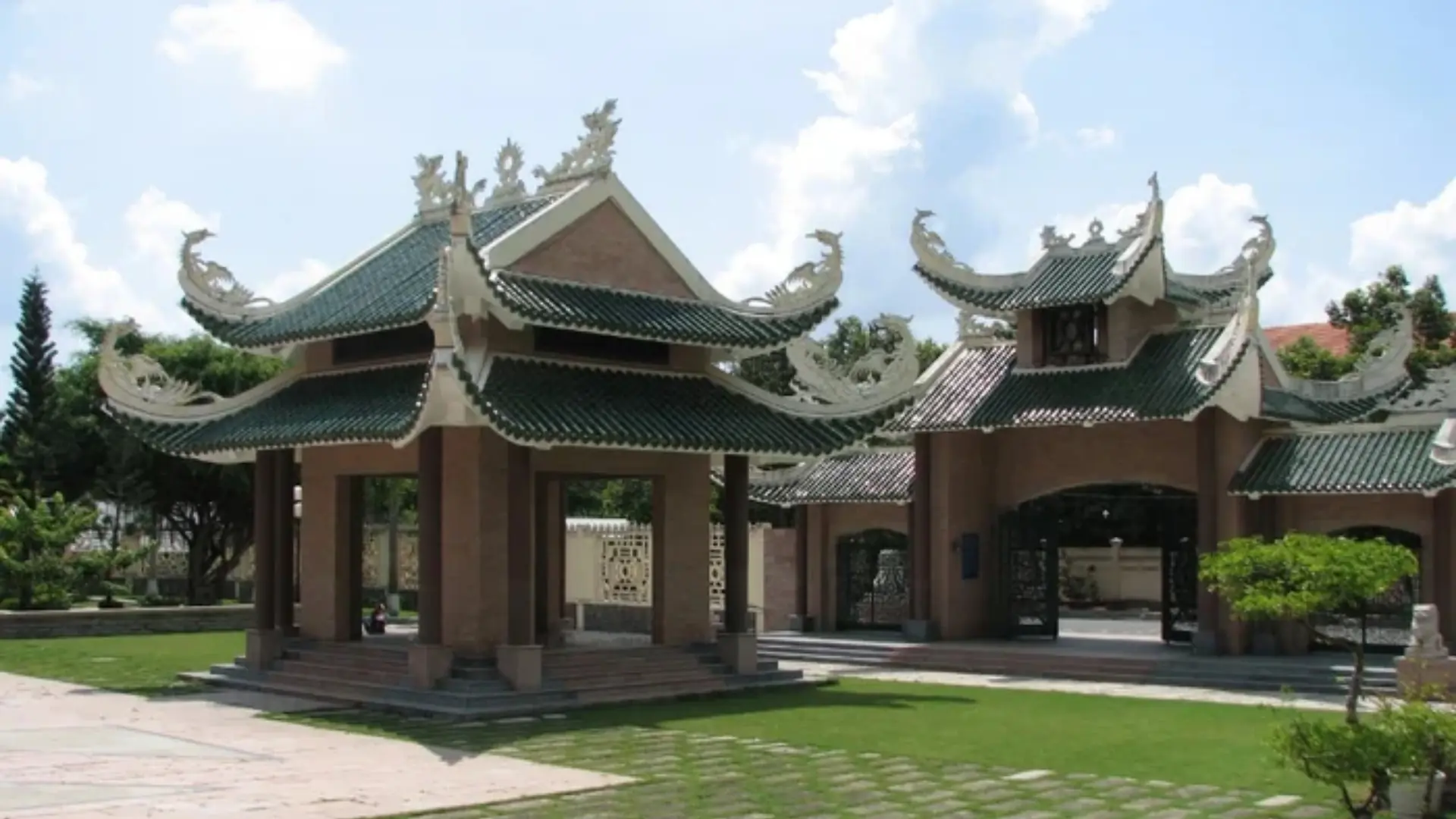
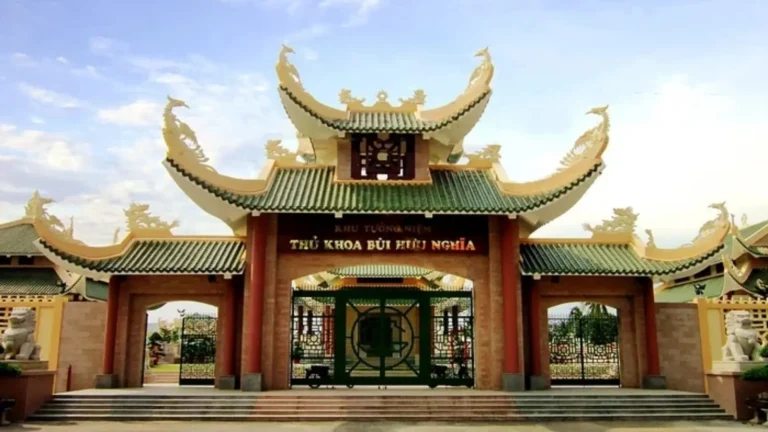
The main entrance is one of the memorial’s most recognizable architectural features.
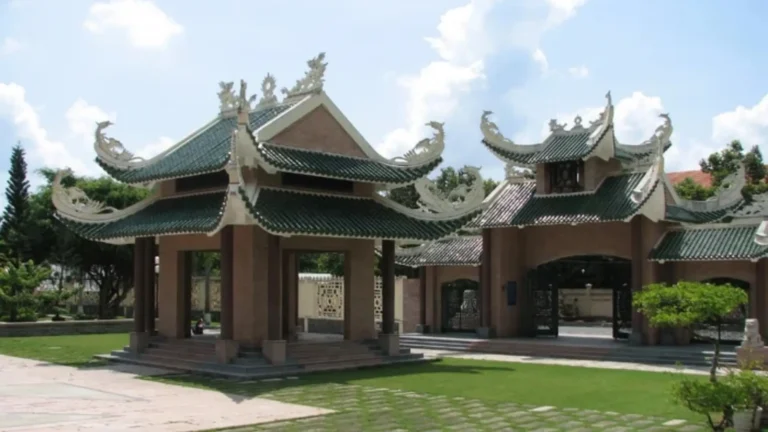
Its green-tiled roofs, curved eaves, and ornamental details draw on traditional Vietnamese design. Dragon and phoenix motifs appear throughout the complex, alongside large columns and carefully arranged courtyards.
From the gate, visitors can see the main memorial building beyond the open courtyard.
Near the entrance stands the commemorative stele house (nhà bia), which introduces Bùi Hữu Nghĩa’s life and contributions.
This is a useful starting point before moving deeper into the complex, especially if you’re unfamiliar with the scholar’s history.
The Main Memorial Hall
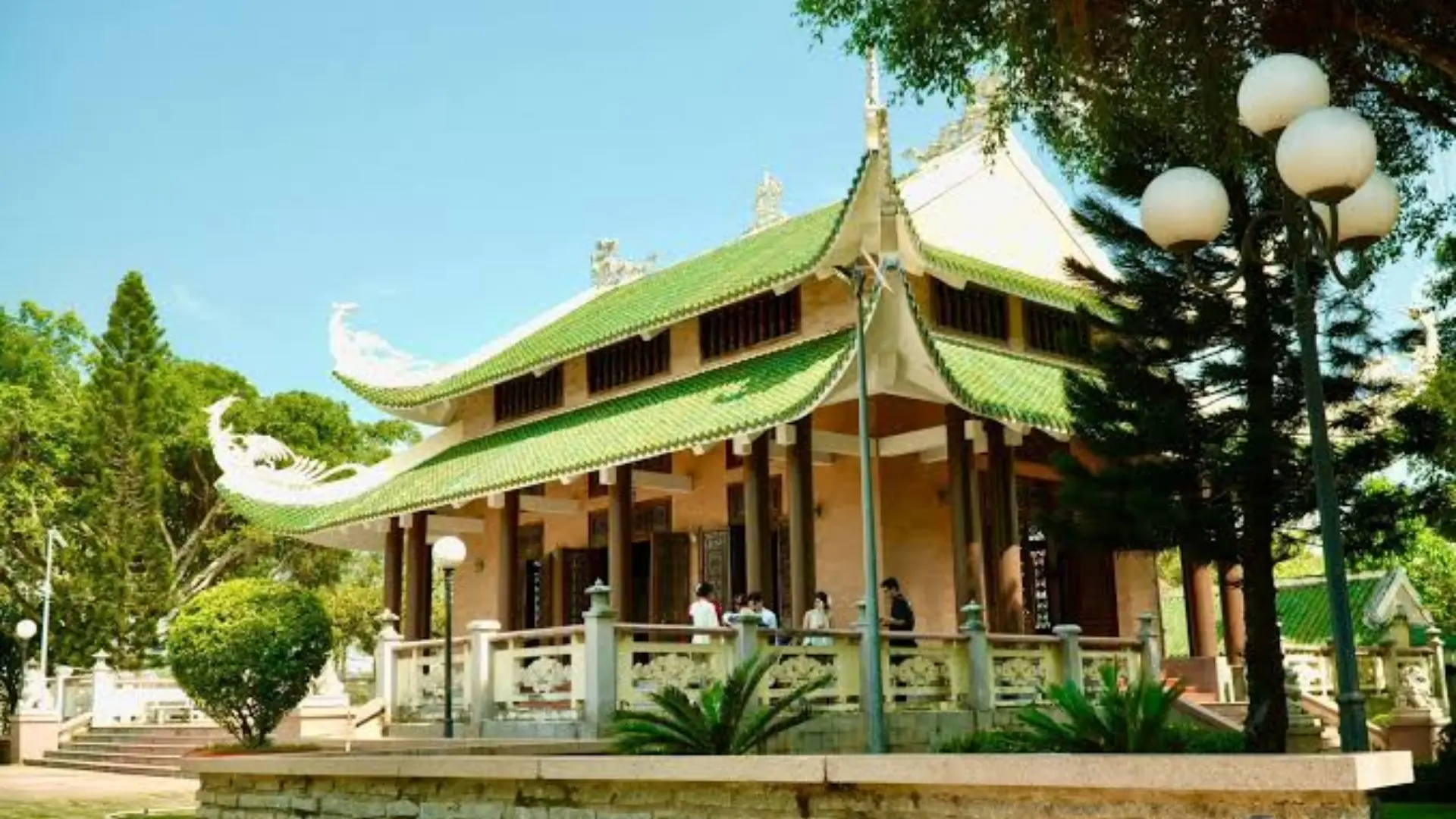
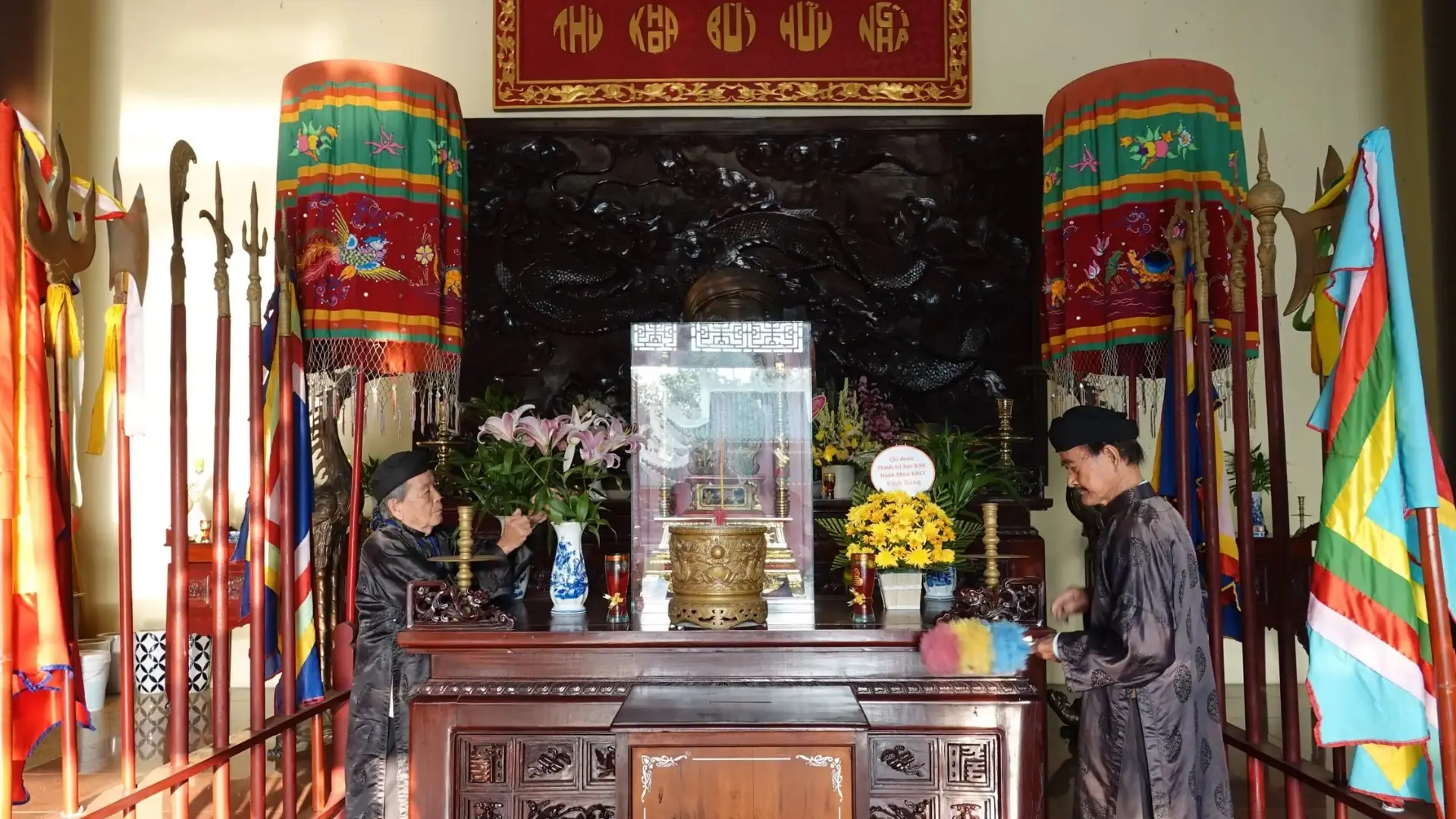
The central memorial hall (nhà thờ tưởng niệm) is the main place of worship and remembrance.
Inside, traditional altar furnishings, carved wooden details, and ceremonial objects reflect the Vietnamese custom of honoring respected historical figures.
Visitors may see local residents offering incense or paying their respects.
Although the building has features commonly associated with Vietnamese religious architecture, it is not a Buddhist pagoda. Its primary purpose is to commemorate Bùi Hữu Nghĩa.
You can enter and observe the space without participating in a ceremony. As with other places of remembrance in Vietnam, quiet behavior and respectful photography are appropriate.
The Historic Tomb
The tomb (Mộ Thủ khoa Bùi Hữu Nghĩa) is located behind the main memorial hall.
It is the historical center of the complex and the reason the site received national heritage recognition in 1994.
The burial area has been restored over time, so its present appearance reflects generations of maintenance and conservation.
For visitors interested in history, this is the most significant part of the grounds. The surrounding buildings tell the story of Bùi Hữu Nghĩa’s life, while the tomb marks his actual resting place.
Take a moment to observe the inscriptions and layout, particularly if you have already read about his career and the events associated with his later life.
The Exhibition Area and Gardens
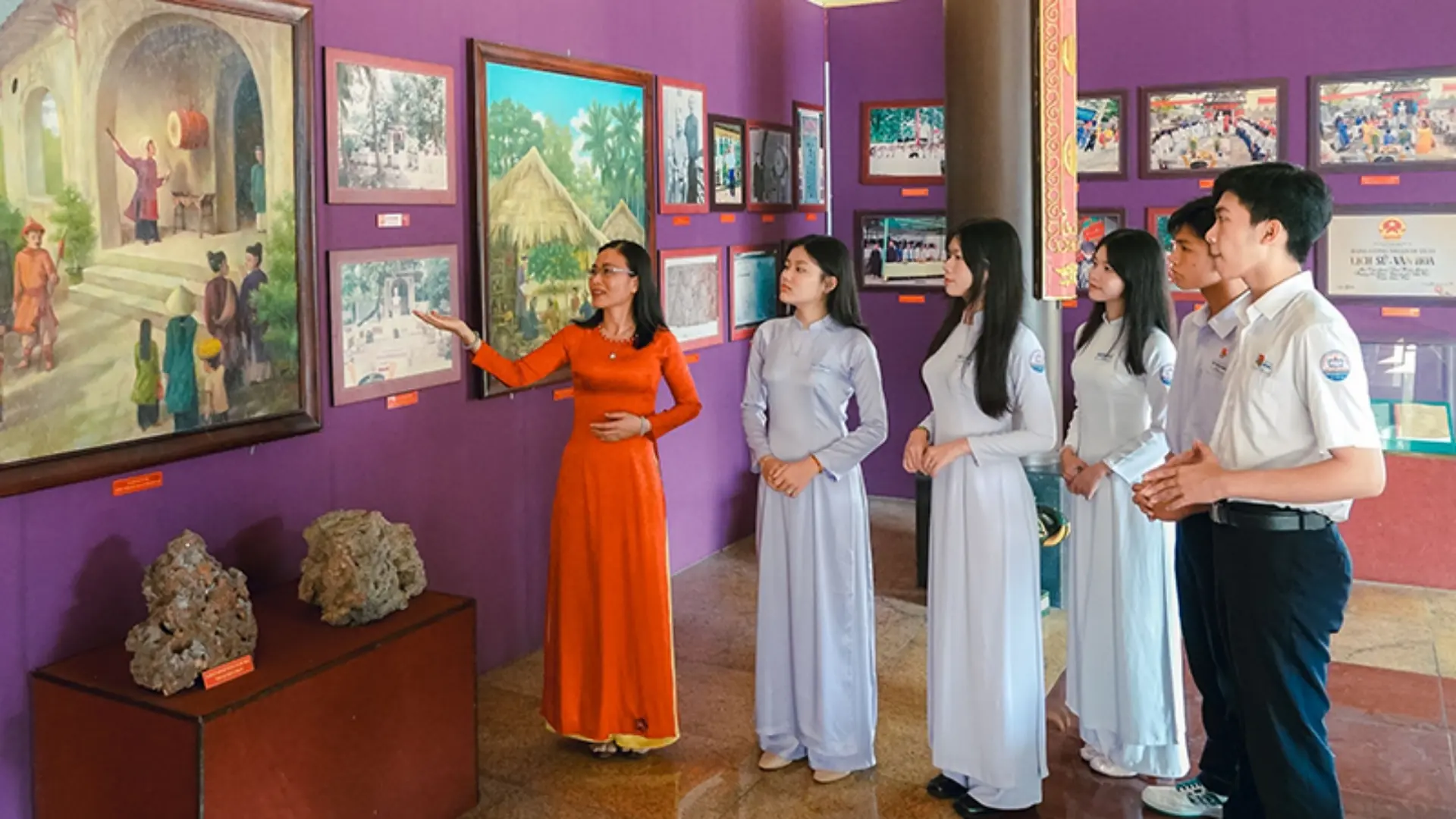
The exhibition building (nhà trưng bày) contains historical information, images, and displays related to Bùi Hữu Nghĩa’s life and literary achievements.
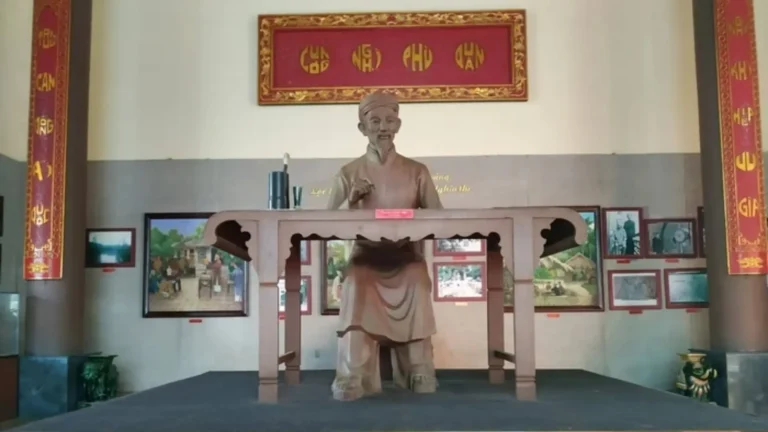
A seated statue depicting him as a scholar at a writing desk is among the visual representations associated with the exhibition.
Some information is available in English, although not every historical explanation is translated. A translation app can be useful for visitors who want to read the Vietnamese displays in greater detail.
Outside, the courtyards and landscaped grounds provide space to walk between the buildings and view the architecture from different angles.
The green-tiled roofs, decorative details, and broad steps of the main hall are particularly good subjects for photography.
Opening Hours, Admission and How to Get There
Opening Hours and Entrance Fee
Bui Huu Nghia Memorial is free to visit.
The published visiting hours are:
- Morning: 7:30 AM-10:30 AM
- Afternoon: 1:30 PM-4:30 PM
- Midday: Closed between sessions
Allow around 30-60 minutes for the main memorial hall, tomb, exhibition area, and grounds.
A longer visit makes sense if you enjoy reading historical displays or studying the architecture.
The separate visiting sessions are worth keeping in mind. Unlike some outdoor attractions in Can Tho, the memorial is not listed as open continuously throughout the day.
Where Is Bui Huu Nghia Memorial?
Address: Huỳnh Mẫn Đạt Street, Bình Thủy Ward (phường Bình Thủy), Can Tho City, Vietnam.
The memorial is approximately 5 km from central Can Tho, depending on your starting point.
A common route from the city center follows Nguyễn Trãi Street and Cách Mạng Tháng Tám Street toward Bình Thủy before turning onto Huỳnh Mẫn Đạt Street.
For international visitors, a taxi or ride-hailing car is usually the easiest option. Traveling by motorbike is possible for those comfortable with local traffic and legally permitted to ride in Vietnam.
When using a navigation app, search for:
Khu tưởng niệm Thủ khoa Bùi Hữu Nghĩa
The Vietnamese name helps distinguish the memorial from other locations named after Bùi Hữu Nghĩa.
Practical Tips for Visitors
- Choose the morning or early afternoon. The grounds include open courtyards, so avoiding the hottest part of the day generally makes the visit more comfortable.
- Dress respectfully. Comfortable clothing is fine, but the site contains a worship hall and historic grave.
- Be considerate when taking photographs. Photography is possible in permitted areas. Follow any on-site restrictions and avoid disturbing ceremonies or people making offerings.
- Bring water and sun protection. Some areas are exposed to the weather.
- Allow time to read the exhibits. Some visitor information is in English, but Vietnamese is the main language used for historical interpretation.
- Don’t assume an English-speaking guide is always available. Visitors can explore independently, but those requiring detailed English interpretation should confirm arrangements in advance.
Planning Your Mekong Trip?
Get a free, personalized itinerary from our local experts in under 120 minutes.

Get a Free Consultation Leave your contact, we handle the rest.
The Annual Bui Huu Nghia Commemoration
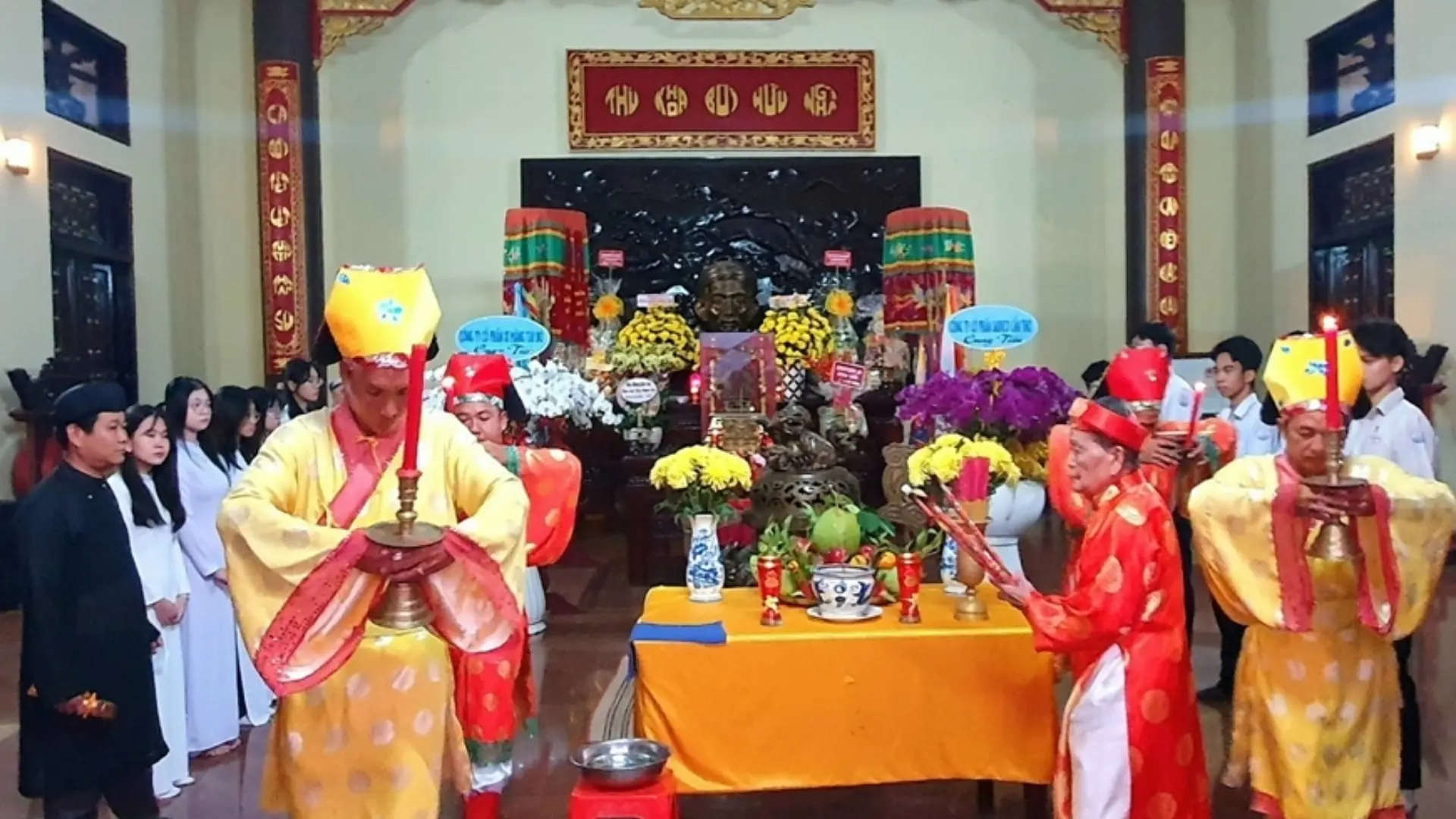
Every year, Bình Thủy holds a traditional ceremony honoring Bùi Hữu Nghĩa, known as Lễ giỗ Thủ khoa Bùi Hữu Nghĩa.
The commemoration takes place during the first lunar month. It brings together descendants, local residents, students, and community representatives to remember his life and contributions.
The ceremonies have traditionally included an offering ritual (cúng Tiên thường) on the 19th day of the first lunar month, followed by the principal memorial ceremony (cúng Chánh giỗ) on the 20th.
Biographical accounts record Bùi Hữu Nghĩa’s death on the 21st day of the first lunar month in 1872. The date of death and the dates on which the traditional ceremonies are organized should therefore not be confused.
In 2026, the 154th commemoration took place on March 7 and 8, corresponding to the 19th and 20th days of the first lunar month. The principal ceremony was held on March 8.
Alongside the traditional offerings, the program included cultural performances and displays of artistic fruit arrangements.
These gatherings show how Bùi Hữu Nghĩa’s memory continues to be part of community life in Can Tho, rather than something preserved only in books or museum displays.
Visitors attending during the annual commemoration may encounter larger crowds and changes to normal access arrangements.
Nearby Historical Attractions in Binh Thuy
Bui Huu Nghia Memorial is a practical stop on a broader heritage outing in Bình Thủy.
The area contains several important cultural landmarks, each connected to a different aspect of southern Vietnamese history.
Nam Nha Pagoda (Chùa Nam Nhã)
Nam Nha Pagoda, historically associated with Nam Nhã Đường, has a direct connection to Bùi Hữu Nghĩa’s commemorative traditions.
Before the expanded memorial was completed in 2013, his memorial tablet (linh vị) was kept at Nam Nhã Đường.
Each year, the tablet was traditionally brought to his tomb for the anniversary ceremony and returned to the pagoda afterward.
On February 28, 2013, the memorial tablet was ceremonially transferred to the newly completed memorial complex, which provided a permanent place for its worship.
This historical connection makes Nam Nha Pagoda a meaningful companion stop, particularly for visitors interested in how local communities have honored Bùi Hữu Nghĩa over time.
The pagoda also has its own history associated with religious practice and patriotic activities in southern Vietnam.
Binh Thuy Communal House (Đình Bình Thủy)
Binh Thuy Temple, more accurately described as Binh Thuy Communal House (Đình Bình Thủy), offers another perspective on the area’s cultural traditions.
Unlike Bui Huu Nghia Memorial, which honors an individual historical figure, the communal house is associated with village worship, community ceremonies, and the local guardian deity.
Its architecture also reflects older traditions of southern Vietnamese communal buildings.
Visiting both places helps explain the different roles that temples, communal houses, and historical memorials have played in local life.
Binh Thuy Ancient House (Nhà cổ Bình Thủy)
Binh Thuy Ancient House is associated with the Dương family and is known for its combination of Vietnamese and French architectural influences.
The family established the original residence in the 19th century, while the present house reflects later construction and renovations.
Its preserved interiors and period furnishings provide an interesting contrast to the ceremonial architecture of Bui Huu Nghia Memorial.
The house also gained recognition as a filming location for the 1992 film The Lover (L’Amant).
Suggested Half-Day Heritage Route
For travelers interested in history and architecture, a visit to Bình Thủy can include four complementary stops:
- Bui Huu Nghia Memorial: Explore the scholar’s history, memorial buildings, exhibition, and tomb.
- Nam Nha Pagoda: Learn about its heritage and historical connection to Bùi Hữu Nghĩa.
- Binh Thuy Communal House: Discover traditional village worship and architecture.
- Binh Thuy Ancient House: Visit a historic family residence with distinctive East-West architectural features.
The sites are best connected by taxi or motorbike rather than attempting the entire route on foot.
Allow roughly half a day, depending on transportation, opening hours, and how much time you want to spend at each stop.
For more information on attractions, food, transportation, and suggested itineraries, see our Can Tho Travel Guide.
Is Bui Huu Nghia Memorial Worth Visiting?
Bui Huu Nghia Memorial is best suited to travelers with an interest in Vietnamese history, literature, and cultural traditions.
It is not a large museum or an entertainment attraction. Most of the visit involves exploring the memorial buildings, reading historical information, and observing a place of remembrance.
Travelers with limited time who are mainly interested in boat trips, food, or river life may prefer to prioritize those experiences.
But for anyone already exploring Bình Thủy, the memorial is a worthwhile stop. It is free, requires relatively little time, and introduces a historical figure whose story remains closely connected to Can Tho.
Explore More of Can Tho
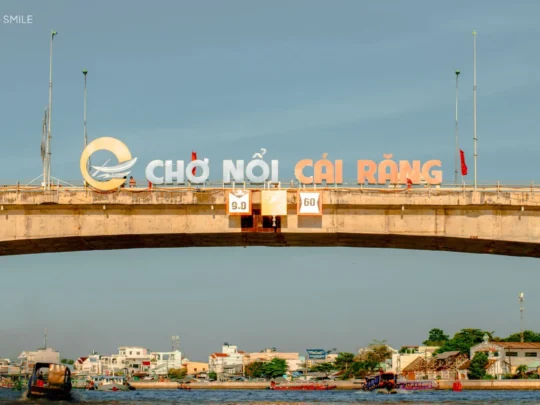
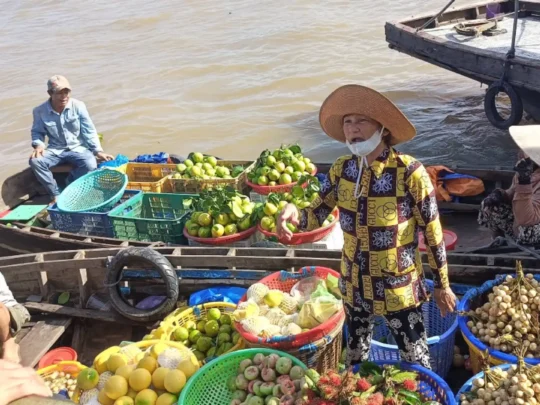
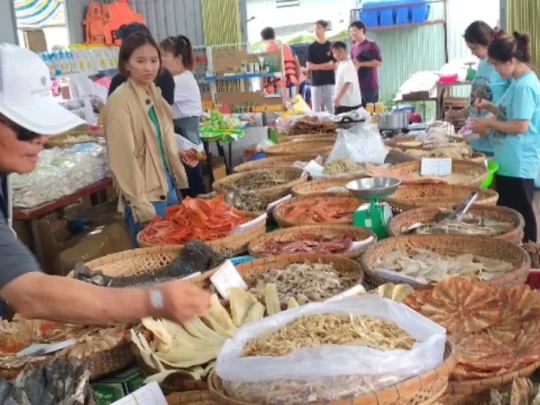
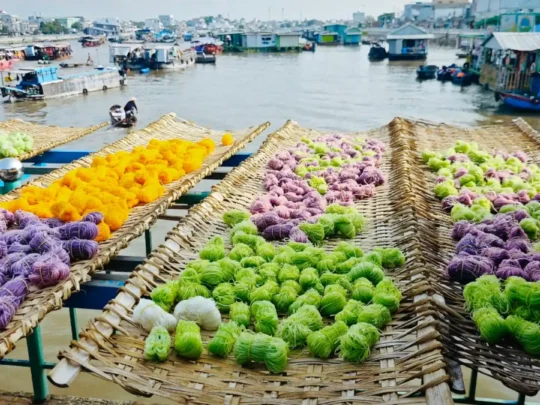
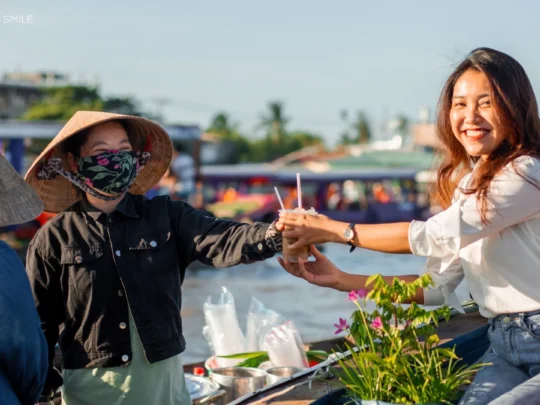
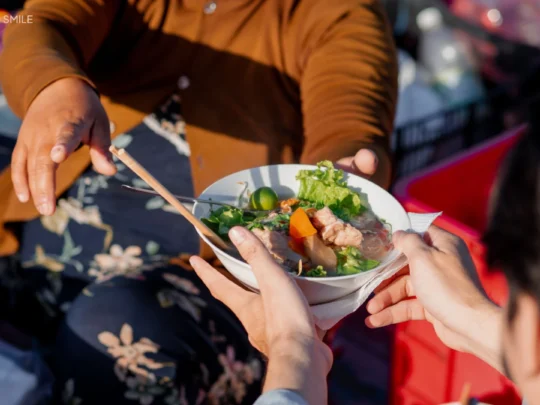
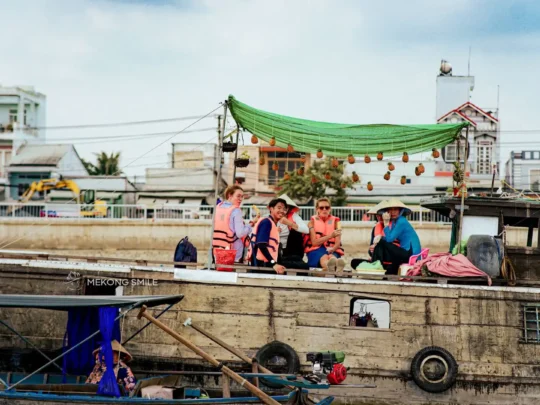
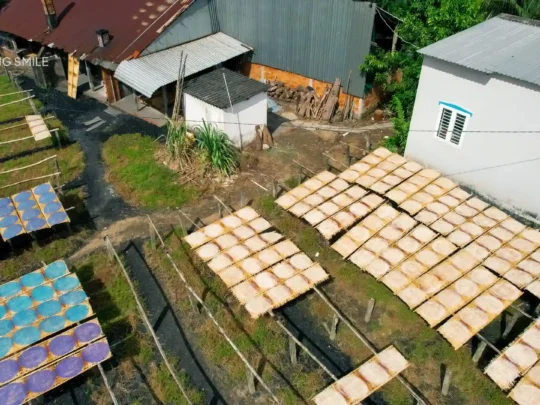
A visit to Bui Huu Nghia Memorial introduces one part of Can Tho’s past. The city’s rivers and floating markets offer another perspective on the communities and waterways that continue to shape everyday life in the Mekong Delta.
For travelers planning to spend more time in Can Tho, the following experiences offer opportunities to explore the region beyond its historical landmarks.
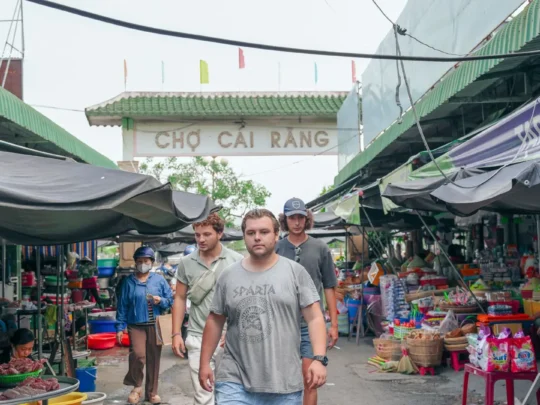
Explore Can Tho Tours & Cai Rang Floating Market Experiences
Planning to explore Can Tho? Browse our selection of tours, including options that feature a visit to Cai Rang Floating Market. Each tour offers a different itinerary, so you can choose the experiences that best match your interests and travel plans.



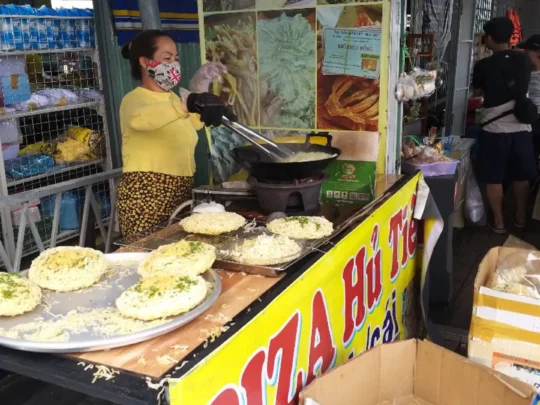
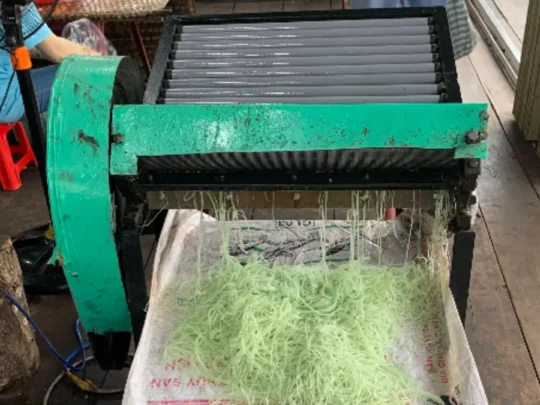
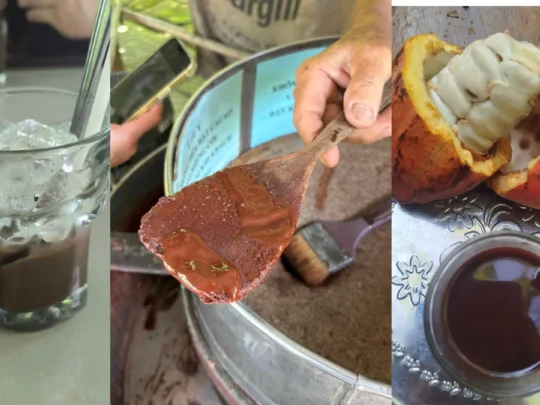
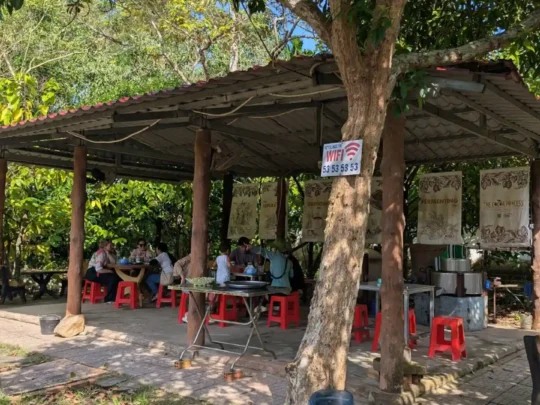


Attractions in Mekong Delta
Cai Rang Floating Market Tour: Cacao Farm, Fruit Garden & Canals





Attractions in Mekong Delta




Attractions in Mekong Delta
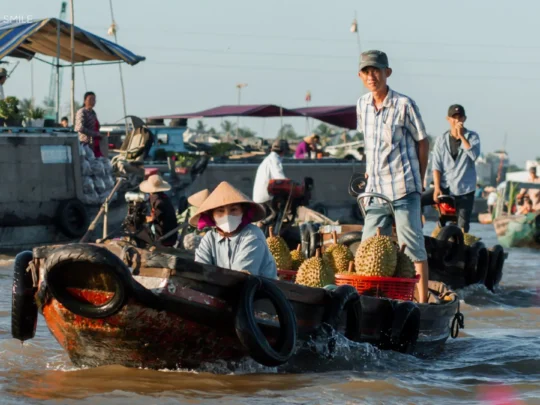
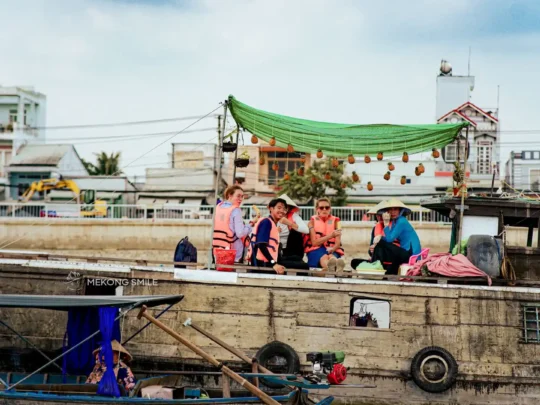
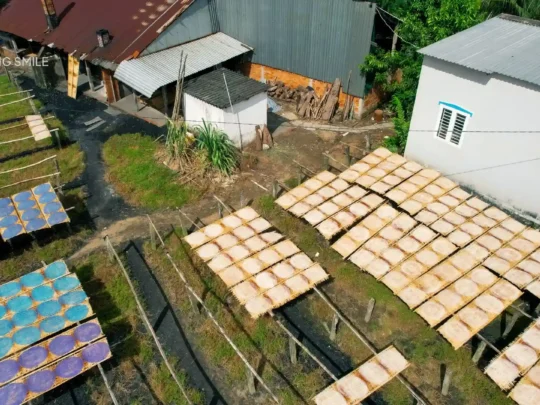
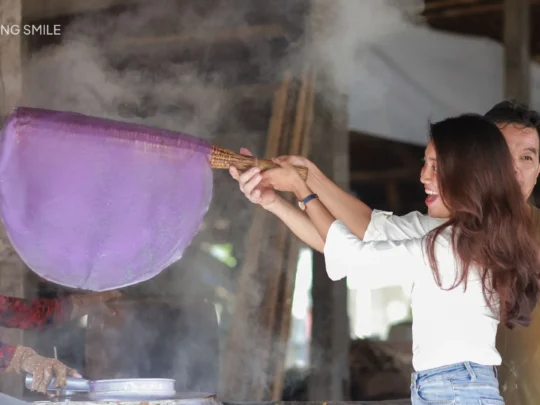
Can Tho Floating Market & Fruit Garden Tour: Mekong Tropical Sense









Attractions in Mekong Delta
Can Tho Rural Tour: Cai Rang Floating Market and Rural Cycling





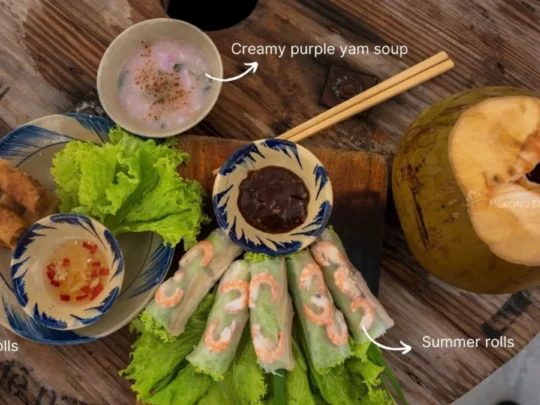
Attractions in Mekong Delta

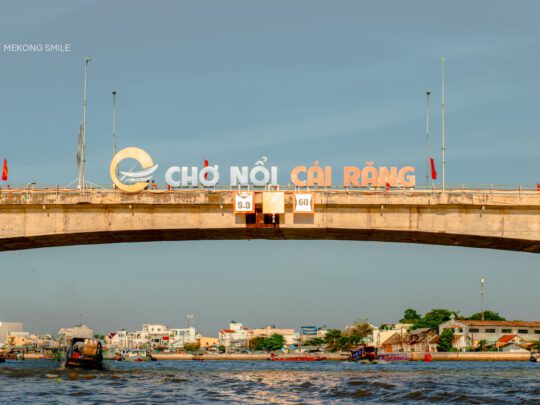
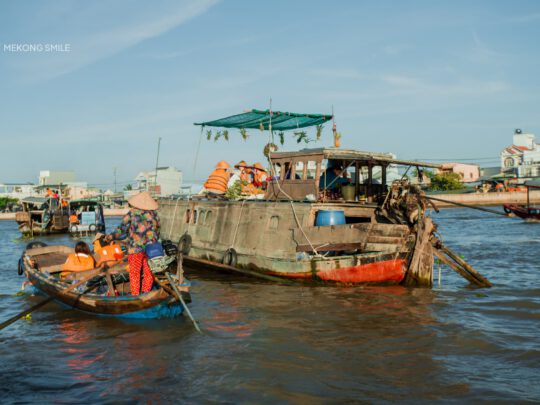
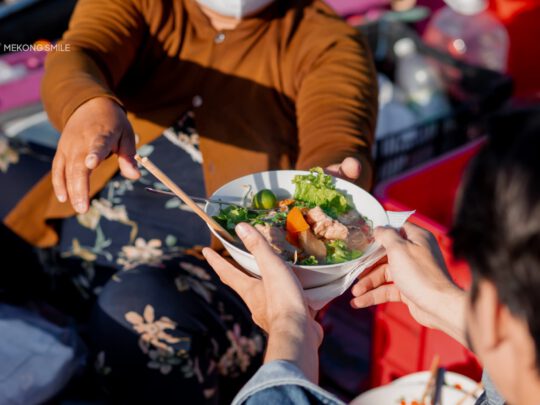
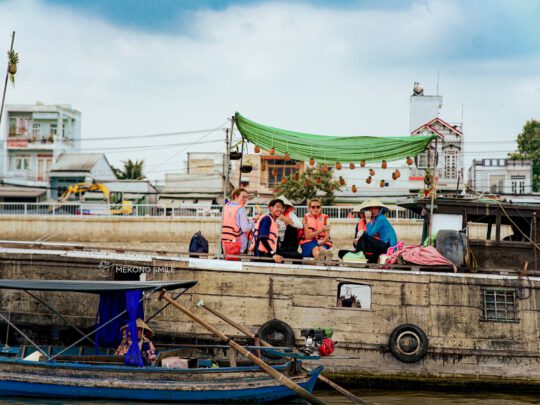

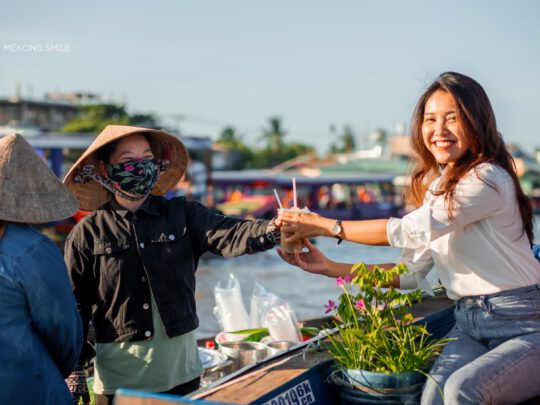
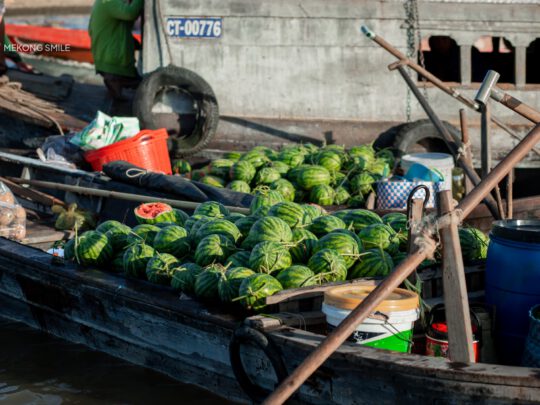
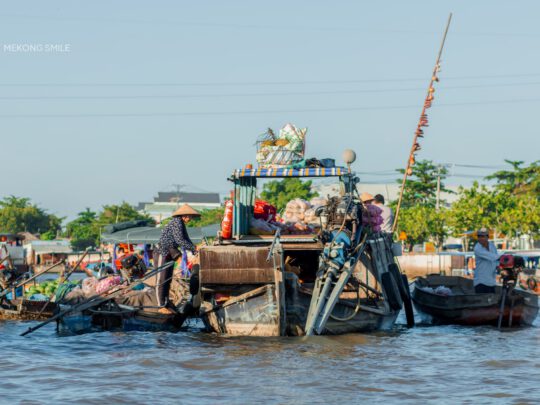
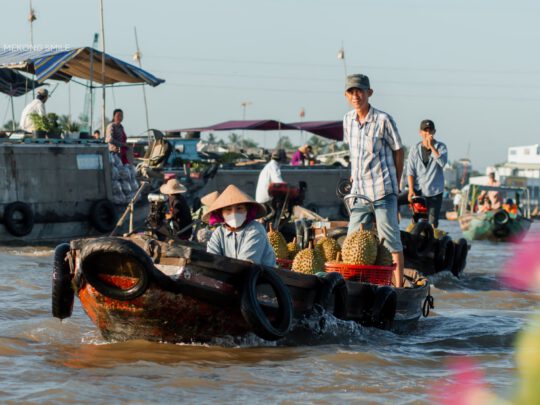




Attractions in Mekong Delta


Attractions in Mekong Delta
Antique Mekong Delta Cruise: Premium Cai Rang Floating Market


Attractions in Mekong Delta
Bassac Cruise Cai Be Can Tho Tour: Authentic Mekong River Journey


Attractions in Mekong Delta



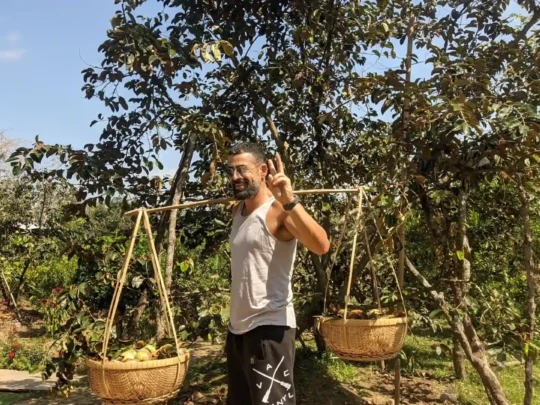
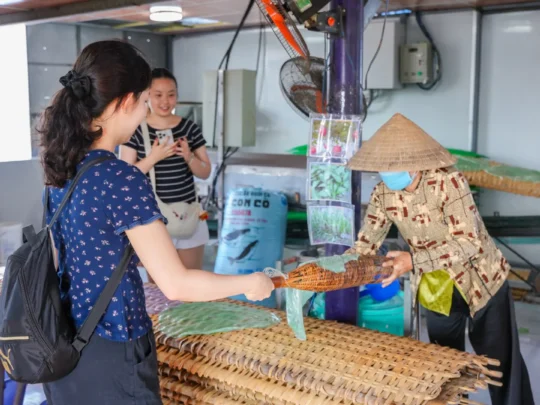
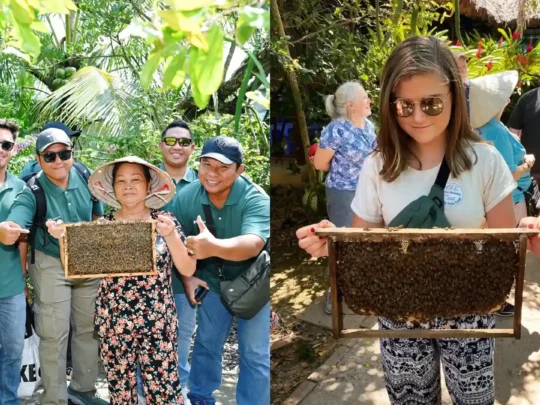
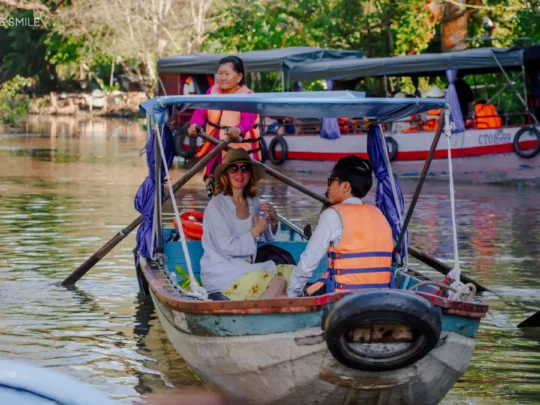







Attractions in Mekong Delta
Mekong Delta 2 Day Tour from Ho Chi Minh City: My Tho – Ben Tre – Can Tho


Attractions in Mekong Delta
Frequently Asked Questions about Bui Huu Nghia Memorial
Is Bui Huu Nghia Memorial the same as Bui Huu Nghia Tomb?
The tomb (Mộ Thủ khoa Bùi Hữu Nghĩa) is the nationally recognized historical site. The memorial (Khu tưởng niệm Thủ khoa Bùi Hữu Nghĩa) refers to the larger complex surrounding it, including the worship hall, exhibition building, and landscaped grounds.
Can I visit Bui Huu Nghia Memorial without a guide?
Yes. Visitors can explore the memorial independently during its published opening hours. Some information is available in English, but not every display is translated.
Is Bui Huu Nghia Memorial a Buddhist temple?
No. It is a memorial dedicated to a historical scholar and official. Although the complex includes a traditional worship hall, it is not a Buddhist pagoda.
Can I combine Bui Huu Nghia Memorial with Cai Rang Floating Market?
Yes, but they are in different parts of Can Tho and offer different experiences.
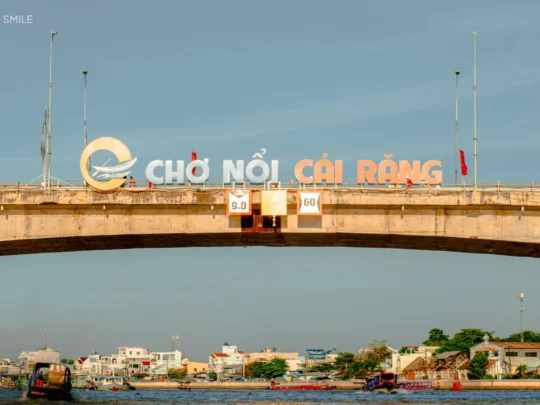
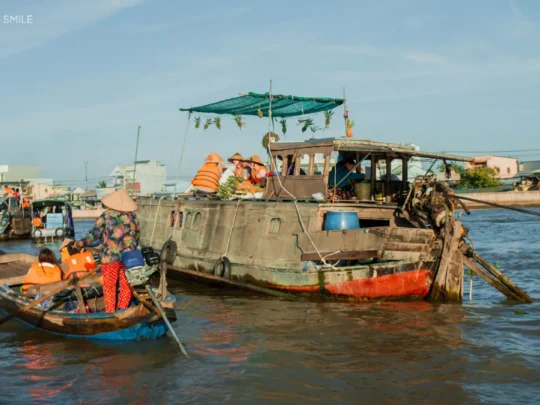
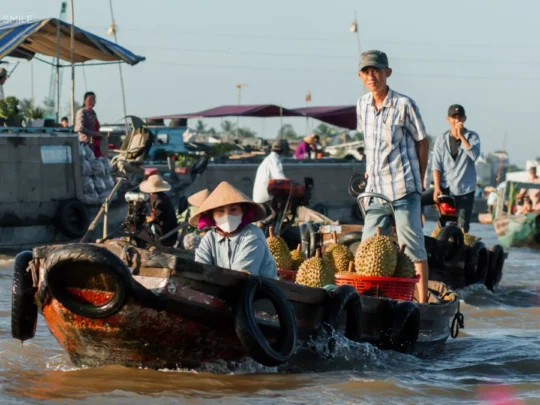
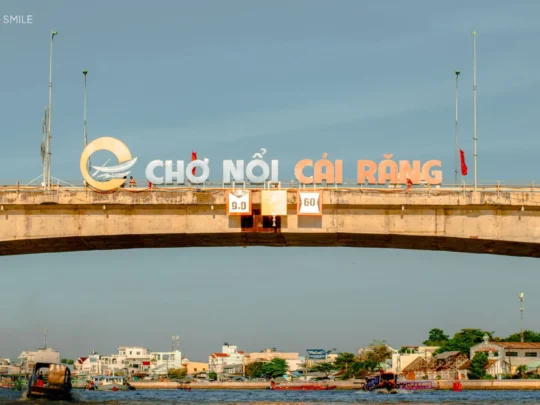
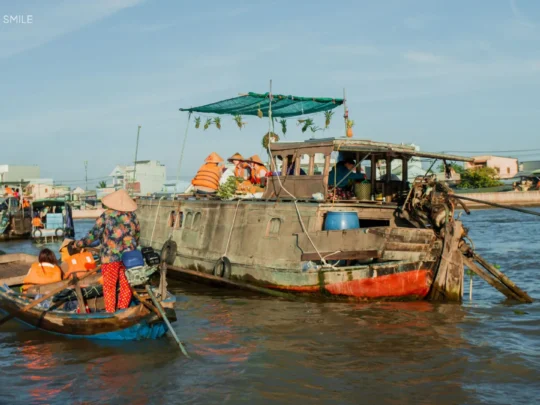
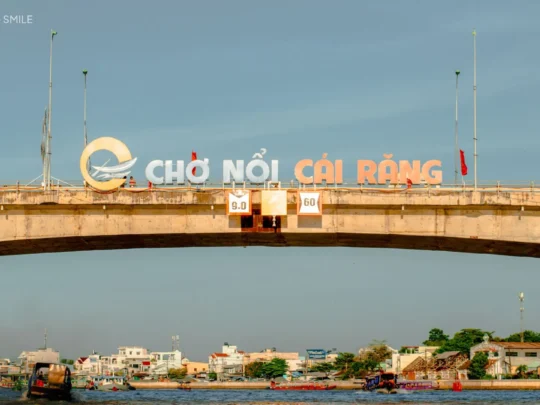
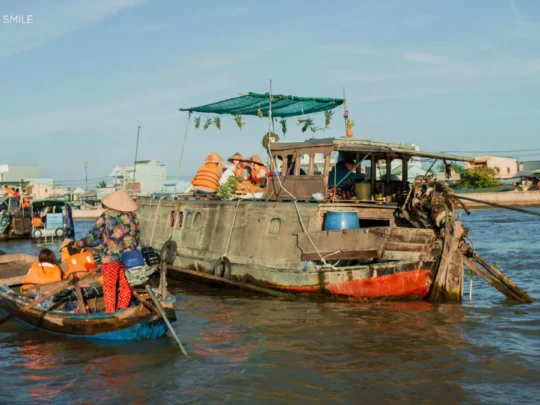
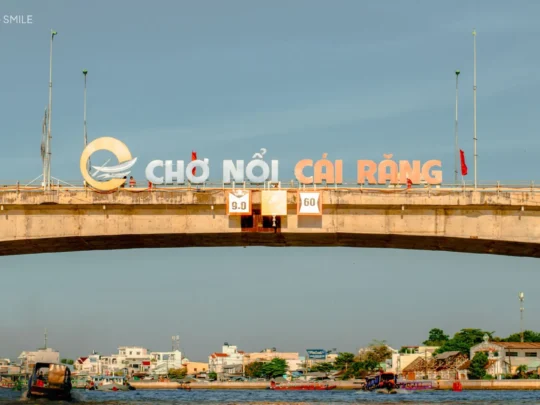
Cai Rang Floating Market (Chợ nổi Cái Răng) is best visited early in the morning, while Bui Huu Nghia Memorial has an afternoon session from 1:30 PM to 4:30 PM.
One option is to visit the floating market at sunrise, take a break around midday, and explore the heritage sites of Bình Thủy in the afternoon.
Check your transportation arrangements and the opening hours of any additional stops before planning the day.

